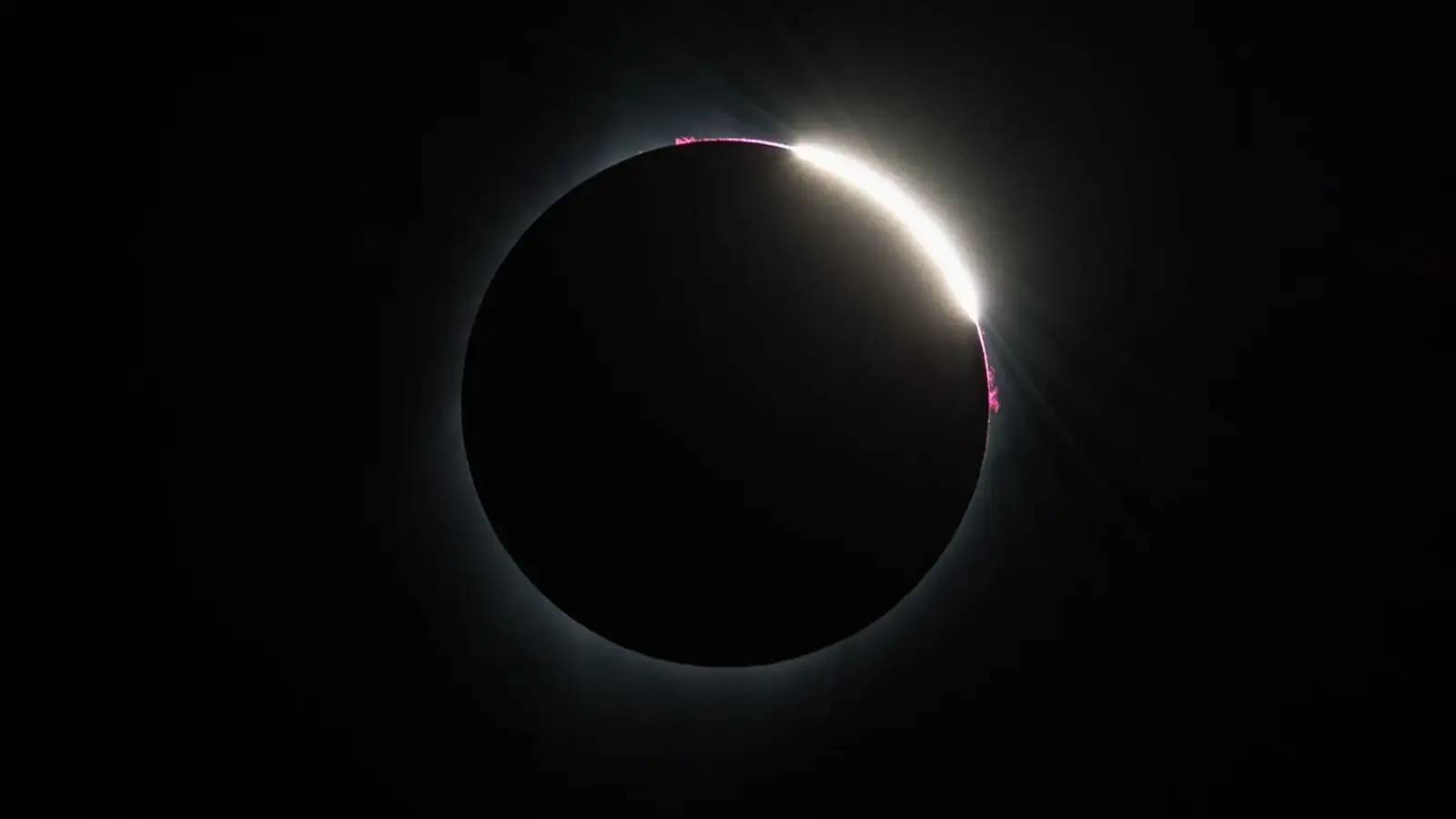
When the Moon’s shadow crosses Greenland, Iceland, the North Atlantic and the Iberian Peninsula on August 12, NASA-funded researchers will turn a brief astronomical alignment into a layered experiment in the sky.
A WB-57 research jet will pursue the shadow at 460 miles per hour, carrying four high-speed cameras 50,000 feet above the ground. Elsewhere along the eclipse path, student teams in Iceland and Spain will release 86 scientific balloons before, during and after the event. Some will measure the lower atmosphere; others will measure ozone, test radio links and film the shadow from near-space.
The path of totality will not reach the United States, although people in some parts of the country will see a partial eclipse. The science nonetheless has a distinctly American footprint: NASA is flying the jet, and students from U.S. universities are participating on all five balloon teams.
The campaigns target two different systems. The aircraft will use the Moon as a precisely placed screen to reveal the Sun’s faint corona. The balloons will use the sudden loss of sunlight as a natural perturbation to ask how quickly Earth’s atmosphere responds. Together they make the eclipse more than an object to photograph: it becomes a short experiment whose baseline begins hours before the sky goes dark.
Chasing about forty extra seconds
From the ground, the longest totality anywhere along the August 12 path will last 2 minutes 18 seconds. For the WB-57, the objective is not simply to avoid clouds. By flying along the Moon’s moving shadow, the aircraft should keep the corona visible for nearly three minutes.
That difference sounds modest, but NASA says the camera suite will capture at least 20 images each second. About 40 extra seconds can therefore add hundreds of frames to the time series, improving the chance of resolving a feature that changes during totality rather than merely comparing its appearance before and after.
The instrument in the aircraft’s nose is the SCIFLI Multispectral Airborne Imager, or SAMI. Its four cameras observe several bands of visible and infrared light. Flying at 50,000 feet places the system above obscuring weather and much of the lower atmosphere, which absorbs some infrared wavelengths before they can reach a ground-based telescope.
NASA flew SAMI during the April 2024 North American eclipse. For 2026, the team plans to adjust exposure times after bright features were overexposed in some of that imagery and to use newer software to process the data sooner. Repeating an experiment with those changes is part of the science: an eclipse cannot be recreated on demand, but the instrument can be improved before the next one arrives.
The Moon hides what instruments struggle to block
The visible surface of the Sun is vastly brighter than its outer atmosphere. Under ordinary conditions, that glare overwhelms the corona from Earth’s point of view. Space- and ground-based coronagraphs create an artificial eclipse with an occulting disk, allowing sustained study of the outer corona, but NASA notes that they still struggle to reveal the region closest to the Sun.
During totality, the Moon itself blocks the bright solar disk. That geometry exposes the low and middle corona without placing an instrument’s occulting hardware next to the solar image. The trade-off is time: the alignment is fleeting and available only along a narrow path.
SAMI will look for structures, outflows and rapid changes in the corona, along with prominences—solar material suspended above the visible surface. The team also hopes to advance one of solar physics’ long-standing questions: how the corona is heated to nearly a million degrees.
The observations connect to a practical chain of research. Material and magnetic energy moving through the corona feed the solar wind and occasional eruptions that can disturb satellites, radio systems and power grids. Other instruments observe different links in that chain; for example, NASA’s PUNCH mission has begun tracking eruptions as they travel through the inner solar system. An eclipse camera cannot by itself forecast a geomagnetic storm, but it can sharpen the picture of the region where solar outflows take shape.
Eighty balloons will track an artificial sunset
The Iceland campaign asks a different question: what happens when a moving patch of atmosphere loses direct solar heating far more abruptly than it does at an ordinary sunset?
Two U.S. university teams will release 80 Graw radiosondes in Iceland. The project’s plan describes a broader 30-hour campaign, running from 00:00 UTC on August 12 to 06:00 UTC the next day. Within that baseline, radiosonde flights are scheduled to begin about 18 hours before the eclipse and continue until eight hours afterward, becoming more frequent around sunrise, the eclipse and sunset. Instruments at the surface will also record local meteorological conditions.
The main target is the planetary boundary layer, the lowest part of the atmosphere and the zone most directly influenced by the ground. Solar heating normally drives turbulence that mixes this layer during the day. When the Moon’s shadow removes that energy, the layer can become shallower—a response sometimes described as a collapse.
NASA’s campaign announcement says balloon flights during the 2023 and 2024 North American eclipses found that the boundary layer contracted at clear sites but not in the same way under cloud. Iceland offers a useful contrast. The eclipse arrives late in a long summer day, while variable cloud and the North Atlantic environment may change the response. Profiles on both sides of the event are essential because a single measurement during the eclipse could not separate its effect from the ordinary daily cycle.
The sondes will also examine the tropopause, the boundary between the troposphere and the stratosphere. Any proposed change there will need careful comparison with background variability: unlike a laboratory switch, the Moon’s shadow crosses a moving, structured atmosphere.
Six larger balloons will test ozone and radio links
In Spain, three U.S. university engineering teams will fly two larger latex balloons each, targeting altitudes of roughly 90,000 to 120,000 feet (27 to 37 kilometers). Their payloads combine four tasks: measure ozone, test Long Range (LoRa) radio communication, record the Moon’s shadow with 360-degree cameras and carry experiments prepared with local students.
Sunlight is integral to ozone chemistry. NASA says similar balloon experiments recorded a decrease in ozone during totality in April 2024, although its campaign announcement does not give an effect size. The new flights can test whether that signal appears again when the eclipse comes later in the day, in another season and at a different latitude.
The radio experiment addresses another Sun–Earth connection. A solar eclipse changes ionization in the upper atmosphere, which can alter how radio waves propagate. The balloon teams will test LoRa links rather than treating a single lost or received signal as a result; position, altitude and the time series around totality are what make the comparison useful.
The useful result may be a difference, not a discovery
Eclipse campaigns invite spectacular language because the event itself is spectacular. The more durable science will come from disciplined comparisons: clear versus cloudy conditions, eclipse versus sunset, 2026 exposures versus the 2024 camera settings, and a new coronal structure versus the models that predicted what should be visible.
A repeated boundary-layer response would strengthen the case for a general mechanism. A different response in Iceland could be just as valuable if the 30-hour record shows how long daylight, cloud or surface conditions modified it. Likewise, finding that the updated SAMI settings preserve bright features without losing faint coronal detail would improve the next campaign even if no wholly unexpected solar feature appears.
For observers, totality will pass quickly. For the teams launching balloons through the night and flying alongside the shadow, the meaningful unit is not only those two minutes. It is the carefully measured interval on either side that turns a rare alignment into evidence.