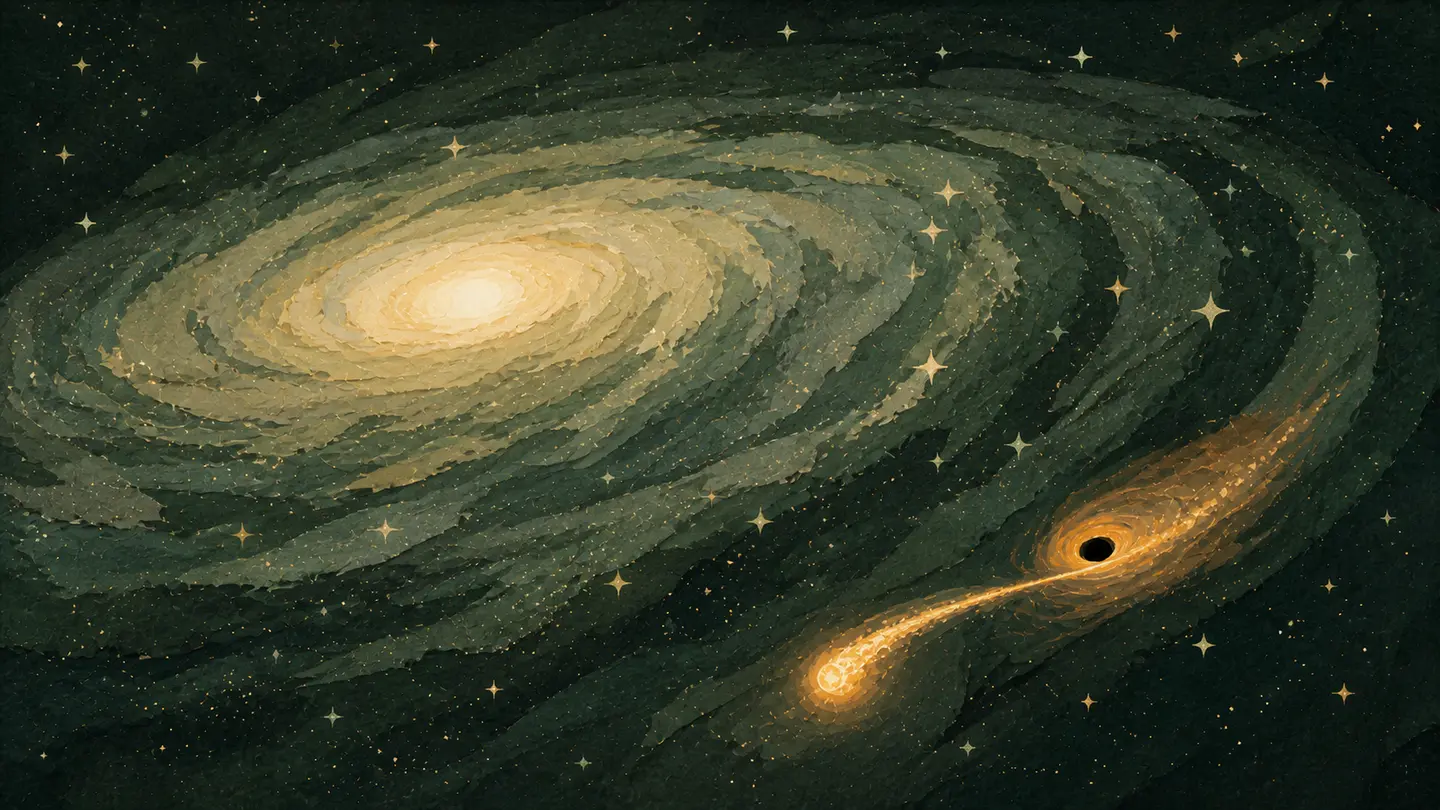
A black hole that was not drawing attention to itself became visible when a star passed too close. The resulting flare, TDE 2025abcr, was not centered on its apparent host galaxy. It appeared about 30,300 projected light-years from the galaxy’s nucleus—a striking offset that gives astronomers a rare way to study a massive black hole in a galaxy’s outskirts.
The event is compelling because one part of the story is well observed and another remains unresolved. Astronomers detected the flare, classified it as a tidal disruption event, and measured its position on the sky. They have not established how the black hole arrived there, whether it is moving away from the galaxy’s center, or whether it instead belongs to the remnant of a smaller galaxy being absorbed.
That distinction matters. NASA’s description of a “wandering” black hole is an evocative shorthand, not a measurement of motion.
A flare selected away from the center
The Transient Name Server discovery record dates the first Zwicky Transient Facility detection to October 13, 2025. Follow-up spectra taken with the Goodman spectrograph on the Southern Astrophysical Research Telescope on November 8 were reported the next day. The spectrum showed hydrogen and helium features consistent with a tidal disruption event.
That timeline is more precise than the simplified version in NASA’s public account, which says the source was first flagged in November. ZTF found the optical transient in October; classification and additional follow-up came in November. NASA’s Neil Gehrels Swift Observatory contributed ultraviolet, optical, and X-ray observations, but it did not discover the transient.
A tidal disruption event occurs when a star approaches a massive black hole closely enough that the difference in gravity across the star pulls it apart. Some stellar debris can heat up and radiate intensely as it falls toward the black hole. That temporary signal can reveal a black hole that had previously been quiet.
According to NASA’s account, the ultraviolet and optical emission reached a temperature near 30,000 degrees Celsius, or 54,000 degrees Fahrenheit, and temporarily radiated with a luminosity equivalent to roughly 10 billion Suns. Those are NASA’s rounded public-facing figures, useful for conveying the scale of the flare rather than independently derived values.
The unusual part was not simply the star’s destruction. It was where the flare appeared.
What “off-center” establishes
The accepted Astrophysical Journal Letters study places TDE 2025abcr 9.5 arcseconds from the host galaxy’s nucleus. At the host’s distance, the authors calculate a projected separation of 9.3 kiloparsecs, or about 30,300 light-years.
“Projected” is essential. A telescope records positions across the two-dimensional sky. The measurement establishes a large apparent separation from the nucleus, but not the full three-dimensional distance between the flare and the galaxy’s center. It also does not show whether the black hole is traveling outward, orbiting within the galactic halo, or embedded in a faint structure that is difficult to see.
The study estimates the disrupting black hole’s mass from a relationship involving the flare’s peak luminosity. Its result, expressed logarithmically as 10 to the power of 6.09 solar masses with substantial uncertainty, places the object around the million-solar-mass scale. That is a model-dependent estimate, not a direct weighing.
The host’s nucleus may contain a much more massive black hole of its own, but that mass is also inferred. The observations therefore support a system with an off-nuclear tidal disruption flare and a likely massive black hole at the flare site. They do not provide a complete inventory of every black hole in the galaxy.
Why the search method matters
Astronomers commonly use a transient’s position relative to a galaxy center as an important clue. Tidal disruption events are naturally associated with the massive black holes expected in galactic nuclei. An optical flare far from a cataloged nucleus can therefore look less like a candidate and more like a mismatch, contaminant, or unrelated source.
The team behind TDE 2025abcr deliberately searched beyond that assumption. ZTF’s custom machine-learning classifier, called tdescore, selected off-nuclear candidates for follow-up instead of treating a positional offset as automatic grounds for rejection. Spectroscopy supplied the classification, while observations across multiple wavelengths characterized the event.
That approach may be the most important part of the discovery. An inactive black hole can be extremely difficult to identify. A tidal disruption flare briefly turns the surrounding region into a signpost. Searching outside familiar galaxy centers could reveal a population that nucleus-focused selection methods are poorly designed to find.
Priority claims, however, become slippery. The discovery paper describes TDE 2025abcr as the first optical tidal disruption event found in the outskirts of its host, while later work calls it the second optically selected off-nuclear event. Rather than declare a “first ever,” the defensible point is measurable: this flare appeared roughly 30,300 projected light-years from the nucleus.
Two histories remain possible
The discovery team discusses two broad explanations. In one, interactions among multiple massive black holes during earlier galaxy mergers ejected this object from the central region. In the other, the black hole remains in the nuclear star cluster of a faint dwarf galaxy that is being stripped during a minor merger with the larger host.
Both mechanisms can put a massive black hole far from the dominant galaxy’s nucleus. The current position alone cannot select between them.
A later JWST and Keck follow-up preprint reports excess infrared emission at the site. The authors say it could arise from free-free emission—a process involving charged particles—or from an unresolved stellar cluster. If the cluster interpretation is correct, its inferred properties favor the stripped-satellite scenario. But the interpretation is conditional, the work is a preprint, and dynamical ejection remains possible.
The open question is scientifically productive. If follow-up observations eventually identify a compact stellar system around the black hole, that would strengthen one history. Evidence about motion or the host galaxy’s merger structure could change the balance in another direction. For now, the event demonstrates location more securely than biography.
A brief flare, and a wider search area
TDE 2025abcr shows how a transient survey can expose a black hole that conventional searches might miss. The star supplied the temporary illumination; spectroscopy identified the nature of the flare; Swift extended the view beyond visible light; and careful astrometry established the unusual offset.
None of those measurements requires a settled origin story to be valuable. The discovery broadens where astronomers have reason to look for otherwise quiet massive black holes. Its most durable lesson is methodological: the outskirts of galaxies should not be dismissed simply because the expected place for a massive black hole is the center.
The black hole’s journey, if it has been on one, is still to be reconstructed.