Space-weather forecasters can often see a coronal mass ejection leave the Sun and determine that it may be heading toward Earth. The difficult part comes next: predicting what the expanding, changing cloud of plasma will do during the long stretch in between.
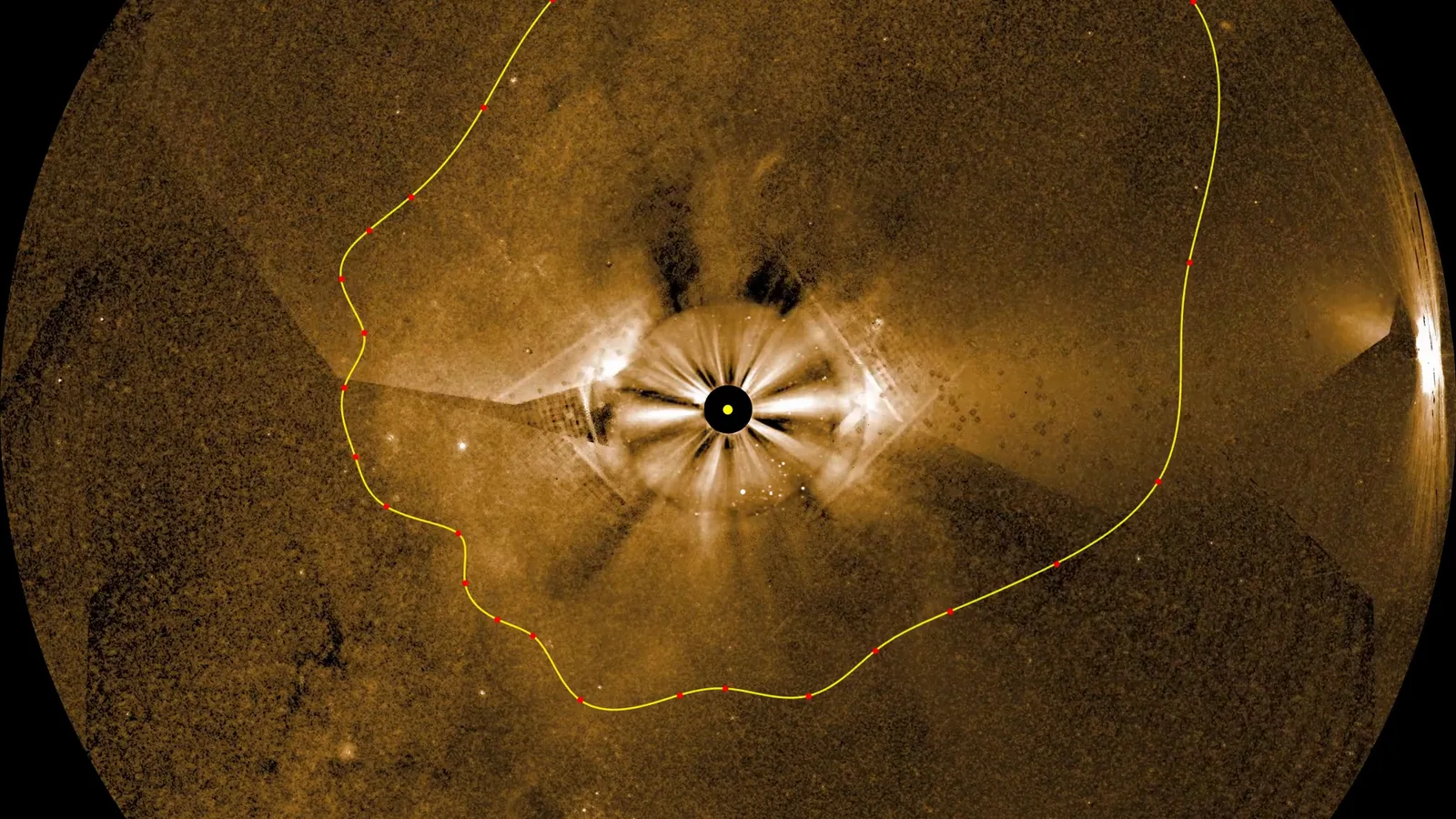
An initial test using NASA’s PUNCH mission suggests that watching that journey continuously could make a large difference. Researchers tracked a May 2025 eruption across the inner solar system and retrospectively predicted its near-Earth arrival to within 30 minutes.
That is an unusually precise result. It is also a proof of concept based on one event, not yet a demonstrated forecasting record.
The blind stretch between the Sun and Earth
A coronal mass ejection, or CME, is a vast release of magnetized plasma from the Sun’s outer atmosphere. If one reaches Earth with the right magnetic orientation, it can disturb the magnetosphere, intensify auroras and interfere with satellites, radio systems and power infrastructure.
Coronagraphs reveal a CME near the Sun by blocking the much brighter solar disk. Forecasters use those early images to estimate the eruption’s speed, direction and size, then feed the measurements into models of the solar wind. NOAA’s operational WSA–Enlil system can provide one to four days of warning.
But an early snapshot leaves important uncertainties. The CME can accelerate or slow down, change shape, be deflected, and interact with the ambient solar wind or another eruption. A 2021 analysis identified both the CME’s initial properties and the modeled background solar wind as major sources of arrival-time error.
Earlier heliospheric imagers have followed some particularly visible eruptions far from the Sun. Routine, detailed tracking across most of the Sun–Earth distance has remained difficult, however. A 2018 assessment of forecasts submitted to NASA’s CME Scoreboard found errors on the scale of hours rather than minutes: across the models, mean errors were about plus or minus 10 hours and standard deviations about 20 hours. Even the best performer in that analysis had a mean absolute error of 13 hours.
Those historical figures are not a direct benchmark for the new result—the events, models and error measures differ—but they show why half-hour precision would matter if it survives broader testing.
Four spacecraft acting as one camera
PUNCH, short for Polarimeter to Unify the Corona and Heliosphere, launched in March 2025. Its four small spacecraft orbit Earth in a coordinated constellation. One carries a narrow-field coronagraph; the other three carry wide-field imagers. Their synchronized observations are merged into one virtual instrument centered on the Sun.
The cameras measure visible light scattered by free electrons in the corona and solar wind. Polarizing filters provide information about where visible structures lie in three dimensions, while the combined field of view connects the outer corona with a broad section of the inner heliosphere. In the inner part of that view, PUNCH produces a polarized image sequence every four minutes.
That continuity is the essential change. Instead of estimating an entire journey mainly from conditions near departure, researchers can repeatedly update the CME’s measured position, shape and speed as it travels.
How the half-hour result was obtained
The event used for the test left the Sun on May 31, 2025. Researchers did not issue a live public forecast at the time. They later fed PUNCH images into a computer model that followed the CME’s leading edge and used its changing speed and geometry to estimate when it would arrive near Earth.
According to NASA’s account, the estimate stabilized 12 hours after the eruption began. At that point, the model predicted an arrival eight hours later. The observed arrival was within approximately 30 minutes of that final estimate.
The model also indicated when its prediction had stopped shifting substantially. That feature may be as useful as the central estimate: an operational forecaster needs to know not only the predicted time but also when the available observations justify confidence in it.
NASA compared the error with a five-hour window from methods currently in use and described the PUNCH result as a tenfold improvement. That comparison should be read as the outcome of this particular test, not as evidence that PUNCH has already made all CME forecasts ten times more accurate.
What this forecast did—and did not—predict
An arrival-time estimate answers a narrower question than the phrase “solar storm forecast” may suggest. It tells operators when a disturbance is likely to reach near-Earth space. It does not, by itself, establish how severe the resulting geomagnetic storm will be.
Storm intensity depends heavily on the magnetic field carried by the CME, especially whether it points in a direction that couples strongly with Earth’s field. NOAA notes that this orientation generally cannot yet be determined reliably until the eruption passes a monitoring spacecraft close to Earth. The PUNCH test tracked the visible leading edge; it did not remove that separate forecasting problem.
There is also a trade-off between precision and lead time. NOAA’s current system is designed to provide a broad warning one to four days ahead. In the PUNCH test, the final stable estimate offered eight hours of notice. The two capabilities are complementary: an early model can flag a possible impact, while continuous images may tighten the schedule as the CME approaches.
The next test is repetition
One successful case can demonstrate that a method is possible. It cannot establish how reliably it will work across the range of events forecasters actually face.
Researchers will need to test PUNCH-informed forecasts on slow and fast CMEs, faint eruptions, glancing impacts, interacting clouds and periods when images are incomplete or difficult to interpret. The analysis must also work quickly and consistently enough for operational use, without depending on extensive manual adjustment after the outcome is known.
If the precision holds across many events, the practical gain would be a better clock. Satellite operators could time protective procedures more closely; grid managers could prepare for the arrival of geomagnetically induced currents; and mission teams could refine plans for spacecraft and astronauts beyond Earth’s strongest shielding.
PUNCH may also improve the physics behind those forecasts. Its first images suggest that CME material is clumpier and continues to evolve more than coarser observations had revealed. Measuring that evolution can help models replace assumptions with observations.
For now, the most defensible conclusion is narrower than NASA’s comparison with a technological revolution. PUNCH has shown, once and retrospectively, that a CME can be watched almost all the way to Earth and that those images can yield a remarkably accurate arrival time. Whether it transforms space weather forecasting depends on what happens when the same method meets the next storms—and the ones after that.