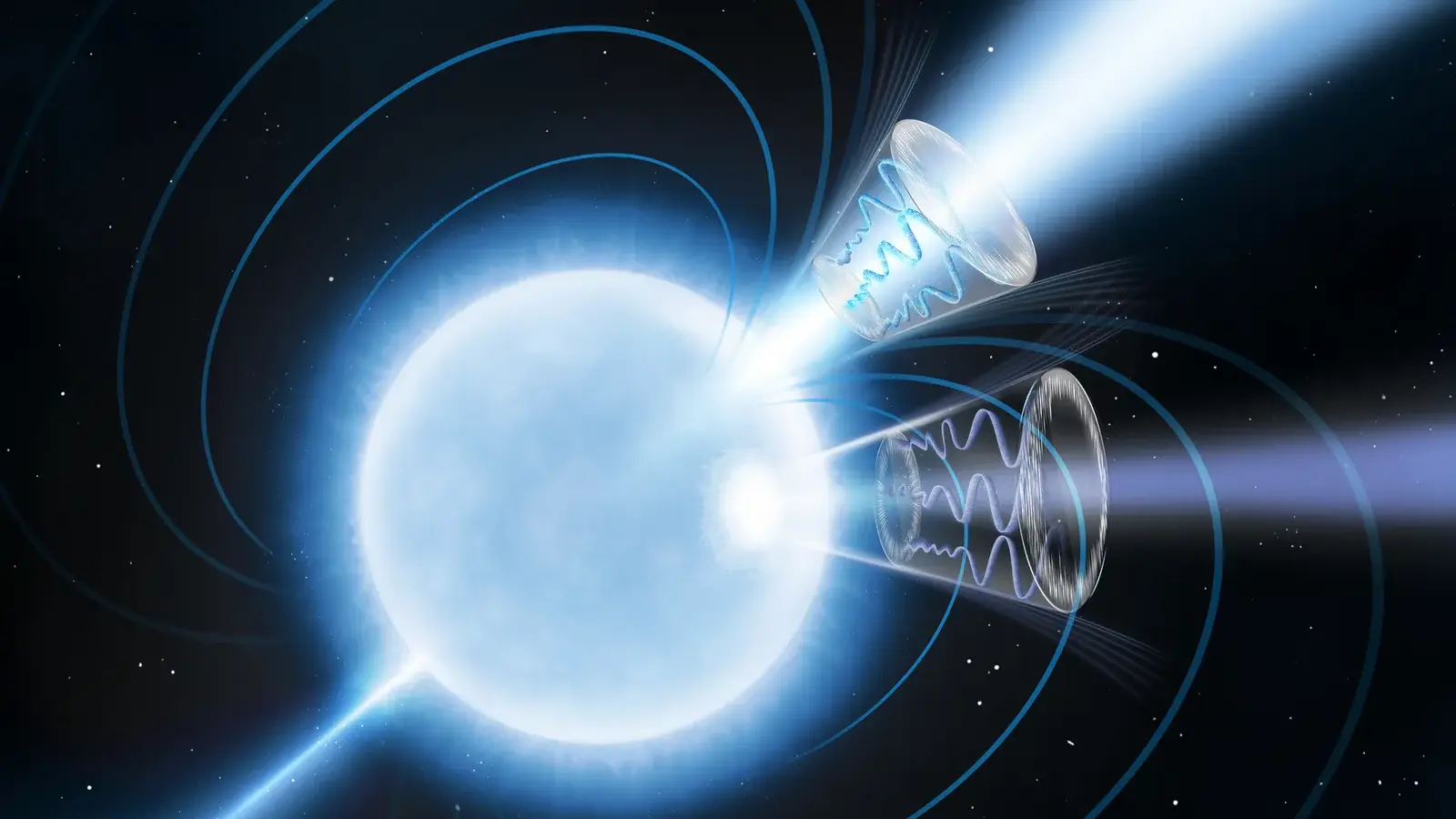
Empty space is not supposed to behave like a crystal. Yet around one of the most magnetic objects in the universe, X-rays appear to be passing through a vacuum that treats different orientations of light differently.
That is the conclusion favored by a new analysis of the magnetar 1E 1547.0-5408. Using NASA’s Imaging X-ray Polarimetry Explorer, or IXPE, alongside an X-ray telescope on the International Space Station and Australia’s Murriyang radio telescope, researchers measured a remarkably orderly signal: at some points during the star’s rotation, nearly 80% of its soft X-rays were polarized in the same way.
The result, published in Nature on August 5, 2026, may be the clearest observational evidence yet for vacuum birefringence, a prediction of quantum electrodynamics dating to 1936. “May” remains important. No detector sampled the vacuum beside the star; researchers inferred its behavior by testing which physical model could reproduce light arriving at Earth.
The strange laboratory around a dead star
A magnetar is a neutron star: the compact remnant left when the core of a massive star collapses. Matter comparable to the Sun’s mass is compressed into an object roughly the size of a city. Magnetars form the extreme end of this already extreme family, with surface magnetic fields above 100 trillion gauss.
The target in this study, 1E 1547.0-5408, completes a rotation in about 2.1 seconds. It is unusual because it persistently emits both bright X-rays and radio waves. That combination let the team compare two views of the same rotating magnetic geometry rather than fitting the X-ray data alone.
Between March and April 2025, IXPE observed the magnetar for more than 140 hours. NASA’s NICER instrument tracked its X-ray timing and spectrum, while Murriyang—the 64-meter radio telescope at Parkes—recorded its radio polarization. The campaign was the first coordinated measurement of both radio and X-ray polarization from a magnetar.
Polarization describes how the electric fields in light waves are oriented. Light emitted by a hot surface normally arrives with a mixture of orientations, especially when a telescope cannot resolve the surface and must add together light from regions with different magnetic directions. A very high net polarization therefore demands an explanation for why so many photons retain a common orientation.
What IXPE actually measured
The polarization was both strong and structured. In the thermally dominated soft X-ray band, the phase-averaged polarization degree reached about 65% at 2 keV, then fell substantially between 2 and 4 keV. When the researchers divided the signal according to the star’s rotational phase, the polarization in the 2–3 keV band approached 80% at some phases and stayed at or above roughly 40% through the portion of the rotation crossed by the radio beam.
The radio and X-ray polarization angles also varied smoothly in a way consistent with a rotating-vector model, in which the observed direction follows the sweep of the star’s large-scale magnetic field. Their peaks did not coincide: the analysis places the main X-ray-emitting hot region away from the magnetic axis traced most directly by the radio beam.
Those details matter more than a single record percentage. The team had to find one geometry that respected the radio constraints while also explaining the energy- and phase-dependent X-ray pattern. Standard models that let light travel from the surface without refractive quantum effects struggled to do that. Models in which vacuum birefringence controls propagation reproduced the observed signatures naturally, according to the paper.
How a vacuum can split light
In classical physics, an ideal vacuum has no material structure and no preferred optical direction. Quantum electrodynamics, or QED, changes that picture. Even a vacuum permits transient quantum fluctuations involving charged particle–antiparticle pairs. Under an exceptionally strong magnetic field, those fluctuations make the vacuum’s response depend on the polarization of the light crossing it.
The two polarization modes then experience slightly different refractive indices—the defining feature of birefringence. It is analogous to the way a crystal can split or delay different orientations of visible light, although there is no literal crystal around the star.
For an unresolved neutron star, the predicted consequence is especially useful. As X-rays leave different patches of the surface, the strong magnetic field keeps their polarization directions coupled to the local field over a large region. By the time that coupling weakens, light from otherwise misaligned patches can emerge with more coherent orientations. A distant telescope therefore sees a much higher total polarization than it would if each photon simply preserved the orientation set at the surface.
Werner Heisenberg and Hans Euler described the relevant nonlinear behavior of the electromagnetic vacuum in 1936. Earth-based experiments have tested QED with extraordinary precision in weaker regimes, but magnetic fields capable of producing an easily measurable vacuum-birefringence signal remain beyond laboratory magnets. Magnetars supply the field; astronomy supplies the distance and the complications.
Strongest yet is not the same as first hint
The new result enters a history that is more nuanced than “theory untested for 90 years.” In 2017, Roberto Mignani and colleagues reported optical polarization of 16.43%, with an uncertainty of 5.26 percentage points, from the isolated neutron star RX J1856.5−3754. Their models found the signal large enough to support vacuum birefringence.
That earlier measurement was difficult because the star is extremely faint in visible light, and the inference depended on poorly constrained viewing geometry. The magnetar result adds much stronger polarization, energy-resolved X-ray data, changes over a full rotation and simultaneous radio constraints. It is better described as the most definitive astrophysical signal so far, not the first occasion on which astronomers saw suggestive evidence.
The next test is whether the pattern repeats
One magnetar can provide an unusually powerful natural experiment, but it cannot reveal by itself how reliably the method works. Additional IXPE observations can test whether the high polarization returns, whether it changes as the source’s activity changes and whether comparable signatures appear in magnetars with different fields, temperatures and viewing angles.
Theoretical work matters just as much. Researchers must explore whether more complex surface atmospheres, magnetospheric scattering or non-dipolar magnetic fields can mimic parts of the signal. If models that omit vacuum birefringence continue to fail across several objects while QED-based models predict their different patterns in advance, the case will become much harder to dispute.
The achievement here is not that a telescope “proved quantum physics.” QED was already among the most thoroughly tested theories in science. The advance is more specific and more interesting: polarization has become precise enough to probe one of QED’s hardest-to-reach predictions in the only magnetic fields strong enough to make it conspicuous.