A position near the middle of a political divide might seem equally distant from both camps. But people who identify with one side do not always perceive that midpoint neutrally. In a series of experiments, they often placed a non-extreme policy or hypothetical person closer to the opposing group.
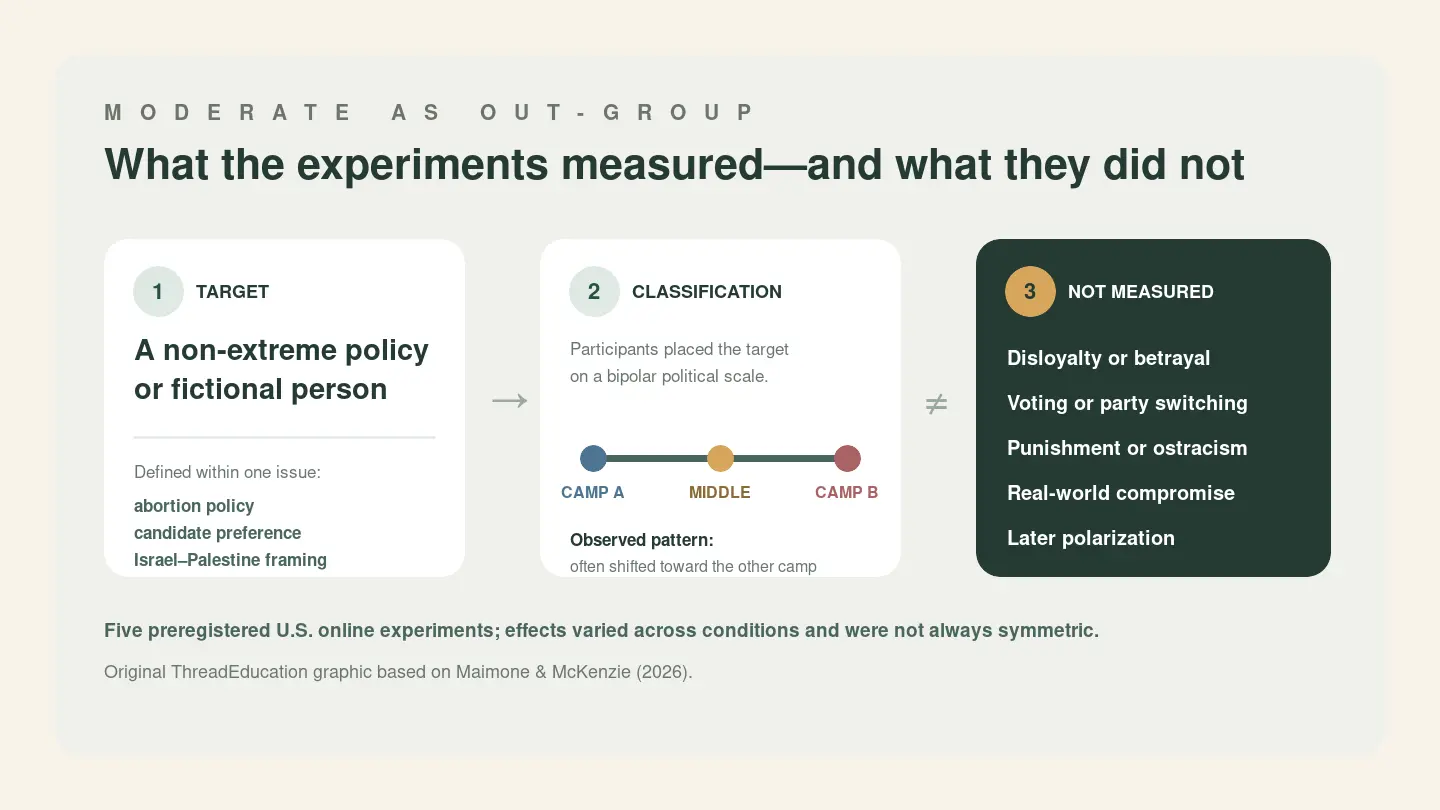
Researchers Giulia Maimone and Craig R. M. McKenzie call this the “moderate as out-group” effect. Across five preregistered U.S. online studies, participants evaluated positions involving abortion, the 2024 presidential candidates, or Israel and Palestine. The pattern appeared in several forms: a person who supported both candidates equally could look more like an opponent, and a policy previously judged moderate could be shifted toward the other camp.
The finding is narrower than the idea that “both sides see moderates as disloyal.” The experiments did not ask whether participants considered anyone a traitor. They did not measure voting, punishment, ostracism or willingness to compromise. And the effects were not symmetrical in every study.
What the work does offer is a controlled look at political categorization: when people see an ambiguous or middle position, where do they place it on a line between “us” and “them”?
Moderation was defined one question at a time
The research, published in the Journal of Experimental Psychology: General, included 3,272 participants in its final analytic samples. The five study samples contained 579, 612, 810, 796 and 475 people. Participants were U.S.-based online workers recruited through Amazon Mechanical Turk or Prolific.
That design matters for interpreting the label “moderate.” The researchers were not studying a stable political identity such as “centrist,” “independent” or “swing voter.” Instead, they created a middle or mixed position within a specific question, then asked participants to place that policy or person on a bipolar ideological scale.
In the first two studies, the issue was abortion. Participants without a partisan position on the issue identified policies allowing abortion through 4, 8 or 12 weeks from conception as moderate. Pro-life and pro-choice respondents then tended to categorize those policies—or a hypothetical supporter of them—closer to the opposite side.
The result was not universal across every condition. In the second study, pro-life participants rated the four-week target as neutral rather than shifting it significantly toward the pro-choice side. That exception is important because the larger pattern should not be rewritten as a rule that every partisan always rejects every midpoint.
A mixed presidential preference produced an asymmetric result
The third study was conducted five days before the 2024 U.S. presidential election. Participants evaluated a hypothetical person who supported Donald Trump and Kamala Harris equally.
Liberals categorized that person as conservative on average. Conservatives, however, categorized the same person as moderate. This was not a mirror-image result in which both groups moved the target equally toward their opponent.
The study also asked participants how morally charged they considered the candidate choice and how threatening they perceived the opposing candidate to be. Greater self-reported moralization and perceived threat were associated with more out-group categorization.
Those associations cannot establish cause. Neither moralization nor threat was experimentally assigned. The stronger suggestion that both were “necessary” for the effect came from an exploratory analysis that was not preregistered and that divided perceived threat into categories. The experiment therefore supports a relationship among the responses, not the conclusion that reducing moral language or threat would necessarily change how people classify moderates.
Tolerating the opponent may matter more than doubting your side
Study 4 tried to separate two possible reasons a mixed opinion might look out-group. Is the problem insufficient enthusiasm for one’s own side, or is it expressing something positive about the opponent?
This experiment recruited Prolific users who identified as both Democratic and liberal. They judged a hypothetical person with mixed opinions about Trump as conservative. But they placed a person with mixed opinions about Harris slightly on the liberal, in-group side.
The contrast supports the authors’ interpretation that, within this design, tolerating the opposing candidate mattered more than imperfect enthusiasm for the preferred candidate. Its scope is limited: only liberals were tested, so it does not show that conservatives make the same distinction.
The design also remained hypothetical. Participants classified fictional people from short descriptions. They were not deciding whether to hire, befriend, campaign with or vote for anyone. A perceptual shift on a scale might influence behavior, but the experiment did not test that next step.
“Both” and “neither” did not mean the same thing
The fifth study changed how a moderate position on Israel and Palestine was framed. One target was presented as “pro-both,” while another was “pro-neither.” These descriptions can occupy a conceptual middle while signaling different relationships to the two camps.
The gap between the camps’ judgments appeared in the pro-both condition and disappeared in the pro-neither condition. That interaction suggests that embracing some aspect of both sides can be perceived differently from rejecting both.
Here again, the group-level result was not a pair of identical effects. Within the pro-both condition, the pro-Palestine participants’ average shift toward “pro-Israel” was not statistically significant. The main evidence came from the interaction between group and framing, not equal mirror-image movement by each camp.
This distinction also guards against a broader mistake. Finding a similar categorization pattern across politically charged issues does not establish moral equivalence between the positions themselves. The experiments examine how labels and group boundaries operate, not whether the underlying political claims are equally justified.
Classification is not disloyalty
The phrase “moderate as out-group” describes the dependent measure precisely: participants located a target closer to the opposing ideological camp. The more dramatic language of “disloyalty” interprets what that classification might mean socially. It was not itself measured.
Someone can categorize a mixed position as closer to an opponent without believing that the person holding it has betrayed a group. The studies also do not reveal whether that judgment lasts, affects a relationship, changes a vote or leads to punishment. Those would require different measures and, in many cases, observations outside a survey.
The sample also limits generalization. Although the five final analytic samples totaled 3,272 participants, they were recruited from MTurk and Prolific rather than drawn as a representative sample of U.S. voters. Attention, completion and internally inconsistent scale judgments led to exclusions from larger raw samples; the supplementary materials also report analyses without those exclusions.
Preregistration and public materials strengthen transparency. The researchers archived their anonymized data, code and preregistrations in ResearchBox and a Zenodo backup under a Creative Commons Attribution 4.0 license. That allows others to inspect how the analyses were specified and reproduced. It does not remove the limits of the samples or turn survey judgments into real-world behavior.
A clue about political boundaries, not a universal law
Taken together, the experiments suggest that ideological categories are relational. A midpoint is not always perceived from a neutral vantage point. When people evaluate it from inside a camp, openness to the other side may become part of the classification itself.
But the variations across the studies are as informative as the recurring pattern. Conservatives did not shift the equal-support presidential target out-group in Study 3. Study 4 tested only liberals. Study 5 found an interaction without significant mirror-image shifts in both partisan groups. These differences show why “both sides” is a summary of the research program, not a description of every result.
The work raises plausible questions for future research: whether these perceptions affect cooperation, whether they persist in real relationships, and whether communication can change them. It does not answer those questions, and the authors’ ideas about reducing moralized language or perceived threat were not tested as interventions.
The defensible conclusion is modest. Under several experimental conditions, participants with partisan positions perceived a non-extreme policy or fictional person as closer to the other camp. That is evidence about group perception. Whether such categorization becomes distrust, exclusion or political behavior remains an open empirical question.