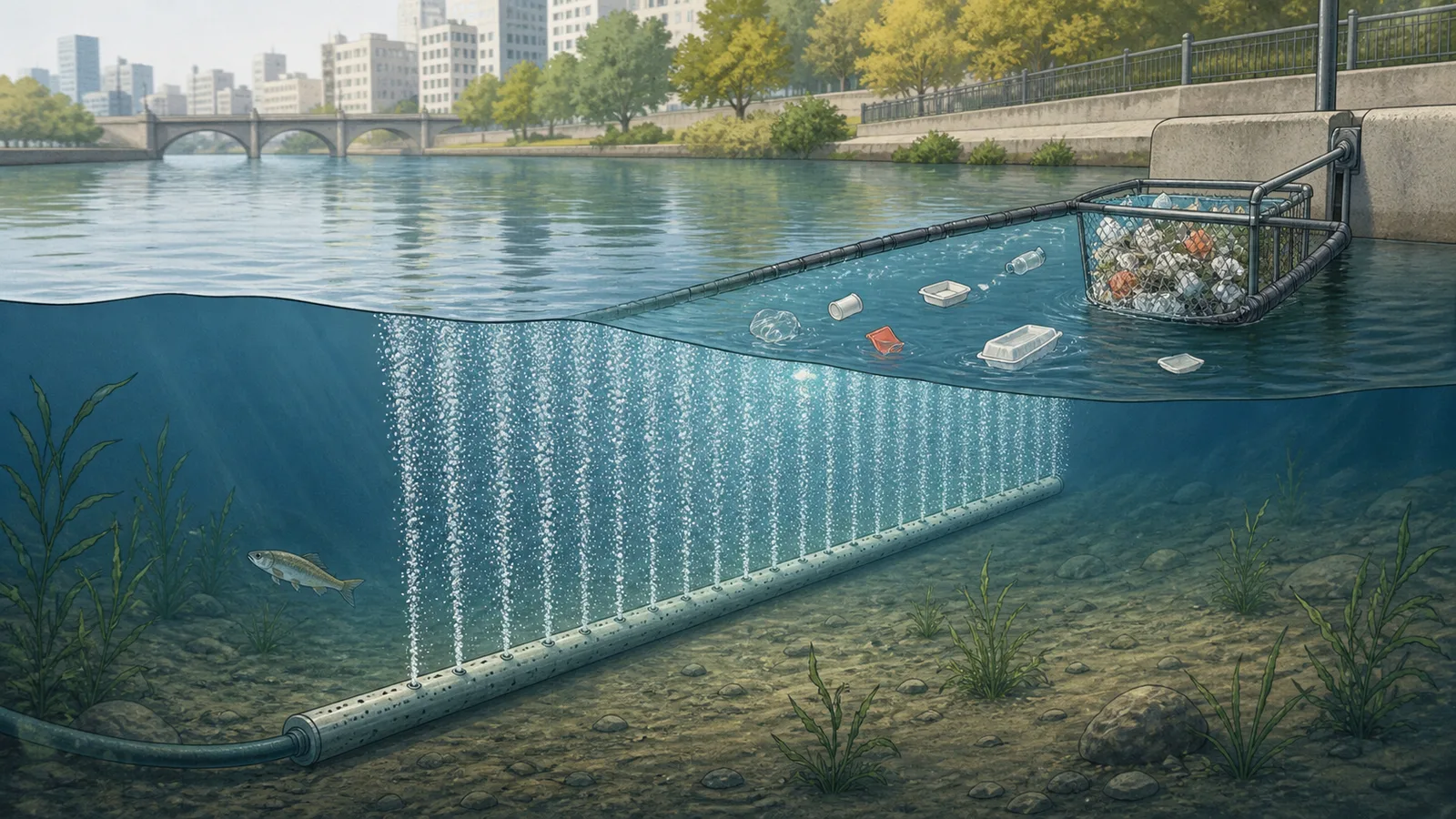
A perforated tube on a riverbed releases a wall of bubbles. The bubbles pull water upward, lifting submerged debris. Set the tube at an angle and the river’s own current carries that material sideways, toward a collection basket on the bank.
It is an elegant piece of fluid mechanics. It leaves the surface open to boats and, unlike a solid boom, can influence waste below the waterline. Permanent systems now operate in several European waterways.
The technology is frequently summarized with an equally elegant statistic: it stops 86% of river plastic before the waste reaches the sea. That number is real, but its usual retelling drops the most important words around it. The developer’s own technical summary says a 180-meter pilot in the River IJssel in November 2017 caught 86% of test material. It does not say every bubble barrier removes 86% of the ambient plastic passing a site.
This distinction does not make bubble curtains ineffective. It tells us what the available evidence can—and cannot—support.
Why the bubbles move plastic
Compressed air pushed through a perforated tube forms a vertical plume of small bubbles. As those bubbles rise, they entrain surrounding water and create an upward circulation. Buoyant litter is already near the surface; material suspended lower in the water column can be carried upward with that flow.
The diagonal installation provides the second part of the mechanism. Water crossing the curtain continues downstream while the induced circulation adds a sideways component. Floating material follows the resulting flow toward one bank, where a boom or basket retains it for removal.
This design avoids blocking the navigation channel. Fish can physically cross the curtain, although “does not hinder fish” is too broad as a general ecological conclusion. Responses to bubbles vary by species, life stage, water velocity, sound and installation. The developer includes passage routes and says it assesses local ecology for each project; that site-specific work is part of deploying the system, not a detail that can be inferred from the plastic catch rate.
Where 86% came from
The Great Bubble Barrier, the Dutch company behind the installations featured in recent coverage, traces the figure to its first river pilot. Its 2022 technical one-pager describes a 180-meter barrier installed in the IJssel in November 2017 after earlier proof-of-concept and laboratory work. It says the pilot was capable of catching 86% of the test material.
That is useful evidence of feasibility under real river conditions. Test objects can show whether a device redirects items released at known positions and in known quantities. Because researchers know the denominator—how many objects entered the trial—they can calculate a recovery percentage.
But test efficiency is not automatically environmental efficiency. Real river waste varies in shape, density, depth, waterlogging and size. Flow changes with weather and season. Vegetation and sediment can interact with equipment. Some debris travels during short storm-driven pulses, and some never enters the part of the water column affected strongly enough by a given curtain.
Most importantly, measuring the fraction of ambient waste captured requires a credible estimate of all waste that would have passed the site without the device. A basket full of litter supplies the numerator; it does not supply that denominator.
Recent articles have quietly changed “86% of test material in one pilot” into “about 86% of surface plastic,” sometimes adding that the figure is stable across installations. Public material available from the company supports the pilot result and repeats an 86% catch-rate claim, but does not provide a peer-reviewed, cross-site dataset establishing a universal rate.
What long-term operation does demonstrate
Amsterdam’s Westerdok canal has hosted a permanent bubble barrier since 2019, commissioned by the regional water authority and the city. The developer reports that the installation collects an average of 80 kilograms, or 15,536 pieces, of inorganic debris per month.
In a separate one-year monitoring effort with Waternet and the Plastic Soup Foundation, 38,178 pieces of dried inorganic waste from the catch were sorted using the OSPAR marine-litter method. More than 71% of the classified material was plastic. Foam fragments, cigarette filters and pieces of plastic film were the most common items reported.
Those data answer two practical questions. The machine captures real debris over long periods, and its catch can reveal what kinds of waste move through the canal. That second function has policy value: recurring product types can point investigators upstream toward sources and prevention measures.
The figures do not answer a third question—what percentage escaped. The published summary describes material in the collector, not matched sampling of the full debris flow before and after the curtain. It therefore supports “this system removes waste” much more directly than “this system removes 86% of waste.”
Laboratory research explains why results vary
A 2022 study in Science of the Total Environment tested bubble barriers in a laboratory channel under different hydraulic conditions. The researchers changed the length and orientation of the bubble generator, measured the resulting flow and tracked particles both lighter and heavier than water.
The system was able to redirect particles, but performance depended strongly on the combination of barrier configuration and the main properties of the flow. That is the fluid-mechanics version of the caveat missing from the headline number: there is no single efficiency detached from a particular river, design and category of debris.
The experiment also concerned controlled particles in a scaled channel. It was not an independent audit of the IJssel or Amsterdam installation. Its value is different: it shows which variables engineers must optimize and why results from one configuration cannot simply be copied to another.
Claims about very small microplastics need special care. The company’s FAQ says its operating barriers catch particles down to about 1 millimeter and describes smaller sizes as an area of research. A bubble curtain may influence sub-millimeter particles in a controlled apparatus, but collecting and retaining them reliably in a full-scale river is a different problem from catching bottles, wrappers and foam fragments.
A downstream tool, not a substitute for prevention
River interception targets a genuine route to the sea. A 2021 global model, calibrated with field observations, estimated that between 0.8 million and 2.7 million metric tons of plastic enter the ocean from rivers each year. It also found that the problem is dispersed: more than 1,000 rivers account for 80% of modeled emissions, with many small urban rivers contributing heavily.
That distribution makes modular interception attractive. A city can install a system near a high-leakage urban catchment instead of waiting for waste to spread along a coast. Yet every installation also needs power for compressed air, maintenance, regular emptying and a functioning route for sorting or disposing of what is collected. Without those services, a successful capture device merely relocates the waste problem to the bank.
Nor can river equipment address the much larger flow of plastic products into society. Reducing unnecessary material, improving collection, preventing litter and holding producers responsible all act earlier in the chain. A bubble barrier is best understood as one layer: it catches part of what those systems failed to contain and generates evidence that may help improve them.
The case for bubble curtains does not need a universal 86%. Their real virtues are more concrete: they can operate without a solid obstruction, recover visible waste continuously and turn that catch into local data. The next step for the field is equally concrete—publish comparable inlet-and-outlet measurements across seasons and sites, with separate results by particle size and buoyancy. That would replace a durable pilot statistic with the evidence needed to decide where these systems earn their keep.