A blood test cannot currently tell someone when they will develop amyotrophic lateral sclerosis. But a new study suggests that patterns across 19 proteins in plasma could eventually help researchers identify people with certain ALS-linked genetic variants who are most likely to develop symptoms within the time frame of a prevention trial.
That distinction matters. The work, published in Nature Medicine, is aimed primarily at designing better clinical trials, not screening the general population or providing individuals with a countdown to disease. Its strongest evidence comes from a small, intensively followed group of people at elevated genetic risk of ALS or frontotemporal dementia, and its timing estimates were still off by an average of more than a year and a half.
The result is promising because prevention trials face a basic logistical problem: researchers may know that a person carries a disease-associated variant, but not whether symptoms will appear soon enough for a trial to measure a treatment’s effect. A biomarker that narrows that window—even imperfectly—could make those studies more practical.
Following biological change before symptoms
The study drew on Pre-fALS, a single-center project that follows carriers of ALS- and FTD-associated pathogenic variants across North America. Researchers use the term “phenoconversion” for the transition from being an unaffected carrier to developing clinically manifest ALS or FTD.
The discovery analysis included 516 plasma samples collected over time from 137 participants. The group comprised 33 people who developed clinical disease during follow-up, 35 people who already had ALS, 10 presymptomatic carriers who had not converted, and 59 controls. Repeated samples allowed the investigators to examine how protein levels changed as symptom onset approached, rather than relying only on a single snapshot.
After quality control, the team measured 5,298 proteins with the Olink Explore HT platform. Its main trajectory analysis identified 92 proteins that changed significantly before phenoconversion. However, alternative analyses limited to the people who converted identified 73 or 52 proteins, depending on the design. That variation is a reminder that the precise list of signals depends partly on analytical choices.
Some of the changing proteins were associated with neurodegeneration, skeletal muscle, and broader systemic processes. One important marker was neurofilament light, or NfL, a protein released with axonal injury. But the investigators wanted to know whether a combination of signals could provide more information than NfL alone.
From thousands of measurements to a 19-protein panel
The researchers built a core panel of 19 proteins using both data-driven rankings and expert judgment. They then tested whether it could distinguish participants who were approaching phenoconversion across windows ranging from six months to five years.
In fivefold cross-validation, the panel produced area-under-the-curve values from 0.80 to 0.89 across the 0.5-, 1-, 2-, 3-, and 5-year horizons. Depending on the time window and decision threshold, sensitivity and specificity each ranged from 76% to 95%.
Those figures describe performance within the study’s modeling framework. They do not mean that the panel can give any individual an 80% to 89% accurate forecast, and cross-validation within a discovery dataset is not the same as testing a finished model in an independent prospective cohort.
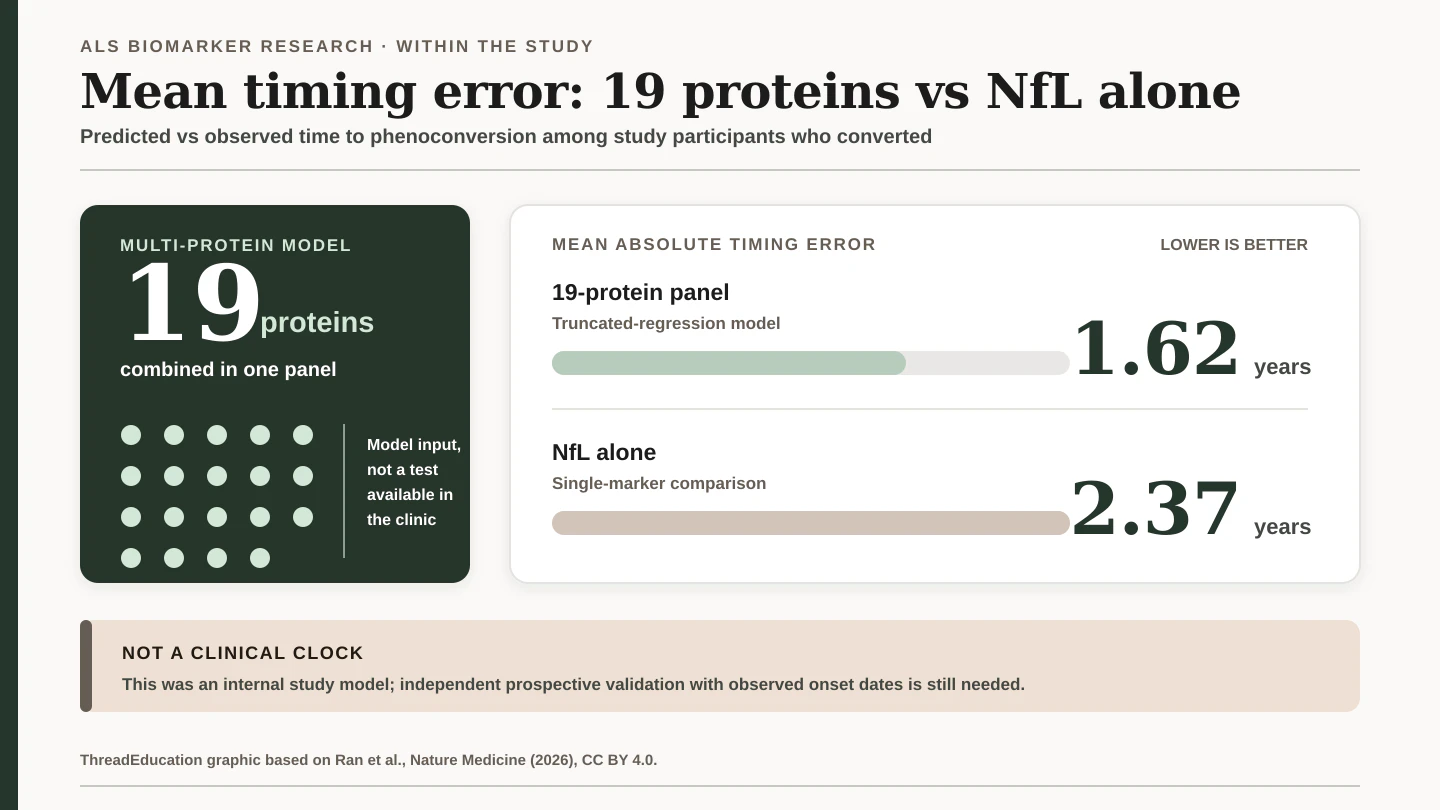
The team also asked a harder question: not simply whether phenoconversion was approaching, but approximately when it would occur. Among participants who converted, a truncated-regression model using the 19 proteins had a correlation of 0.79 between predicted and observed timing. Its mean absolute error was 1.62 years. A model using NEFL alone had a correlation of 0.48 and a mean absolute error of 2.37 years.
The improvement over a single marker is meaningful for research planning. Yet an average error of 1.62 years is far too large to describe the model as a precise personal clock. Some individual predictions would also be closer than the average and others farther away.
Why the UK Biobank analysis is not full validation
The investigators looked for supporting patterns in the UK Biobank, but that dataset differed substantially from Pre-fALS. It provided cross-sectional rather than longitudinal measurements and included 35,722 controls, 38 presymptomatic SOD1 or C9orf72 carriers, 231 people later coded as phenoconverters, 22 manifest cases, and 33 people hospitalized within two years of sampling.
Only 15 of the 19 panel proteins were available. More importantly, researchers did not have directly observed symptom-onset dates for the same kind of prospective follow-up. They imputed onset as two years before an ALS-related hospitalization. Using that approximation, the 15-protein model had a timing error of 2.75 years, compared with 3.61 years for NEFL alone.
The authors therefore describe this as qualitative, directional replication. It suggests that the protein pattern may carry information in another large dataset, but it does not quantitatively verify the panel’s performance or resolve how well it would work in a new group followed from before symptoms.
Other limits also narrow the interpretation. The core discovery group included only 33 phenoconverters and 10 presymptomatic carriers who had not converted. Multiple blood draws enrich the timeline, but they do not create more independent participants. The targeted protein platform also emphasizes known, abundant extracellular proteins, while expert curation can favor existing biological expectations. Performance across different genetic variants remains uncertain, and leading candidates require validation with conventional immunoassays before they could be used to decide trial eligibility.
The paper also reports relevant financial relationships. Senior author Michael Benatar has consulted for Biogen and other companies, and the University of Miami licensed intellectual property to Biogen related to the design of ATLAS. Other authors disclosed commercial relationships. The paper states that Olink did not support the study and had no role in it.
The immediate use case is trial enrollment
The clinical context helps explain why researchers are pursuing presymptomatic biomarkers. In 2023, the Food and Drug Administration granted accelerated approval to tofersen for adults with SOD1-associated ALS, based on a reduction in plasma NfL as a surrogate endpoint considered reasonably likely to predict clinical benefit.
The ongoing phase 3 ATLAS trial is testing tofersen in presymptomatic SOD1 variant carriers with elevated neurofilament. It is active but not recruiting, has no posted results, and lists August 7, 2027, as its estimated primary completion date. Nothing in the new proteomics study shows that tofersen—or any other treatment—prevents ALS.
What the 19-protein panel could offer, if it survives further validation, is a way to enrich such trials with participants whose risk of near-term symptom onset is higher. That could shorten the time required to observe whether an intervention changes the course toward clinical disease.
For now, the advance is best understood as a research tool under development. The longitudinal data show that measurable biological changes can precede clinical ALS in genetically at-risk people, and a multi-protein model outperformed NfL alone within the study. Turning that signal into a dependable trial-selection assay will require independent prospective testing, broader evaluation across genotypes, and laboratory methods suitable for trial use. The study moves that effort forward, but it does not yet put a predictive blood test in the clinic.