The first PCSK9 inhibitor that can be taken as a pill has cleared the central regulatory test for what it was designed to do: lower LDL cholesterol. It has not yet cleared a different and more consequential test—showing that people who take it have fewer heart attacks, strokes or cardiovascular deaths.
The Food and Drug Administration announced the approval of Lipfendra, also known as enlicitide, on July 17, 2026. The once-daily drug is approved alongside diet and exercise for lowering LDL cholesterol in adults with high cholesterol, including those with heterozygous familial hypercholesterolemia, an inherited condition often abbreviated HeFH.
In the two pivotal placebo-controlled trials summarized by the FDA, the adjusted between-group differences in mean LDL change were approximately 56 and 59 percentage points at week 24. Those are substantial effects on a well-established risk factor for cardiovascular disease. But the trials measured cholesterol, not whether this particular drug prevents cardiovascular events. A much larger outcomes trial is underway, with results still years away.
Turning an injectable target into a pill
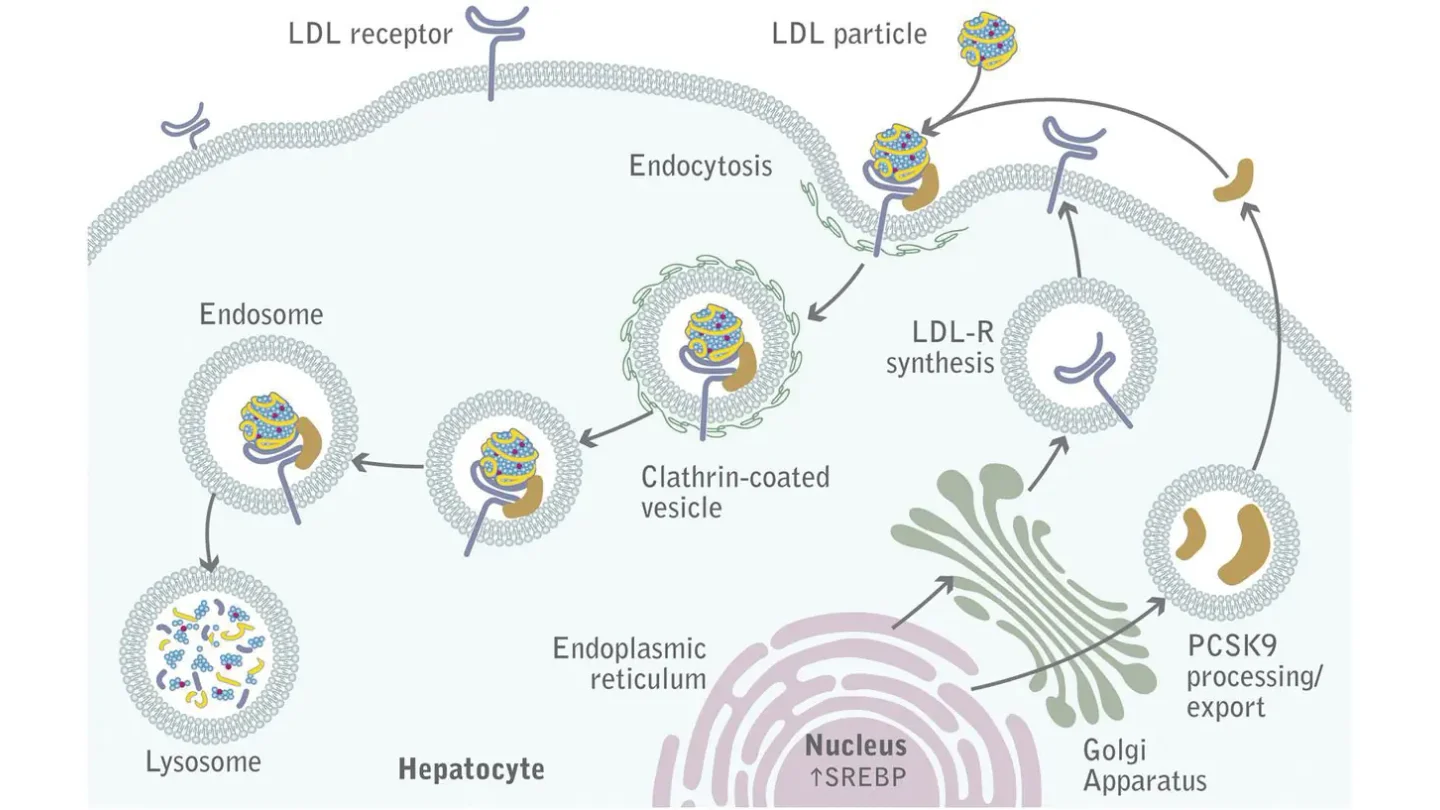
PCSK9 is a protein involved in regulating the liver’s supply of LDL receptors. These receptors pull LDL particles from the blood. PCSK9 promotes their degradation; blocking PCSK9 allows more receptors to return to the surface of liver cells and continue clearing LDL cholesterol.
Existing monoclonal-antibody PCSK9 inhibitors already act on this pathway, but they are injected. Enlicitide is a macrocyclic peptide engineered to bind circulating PCSK9 while being delivered orally. The novelty of the approval is therefore not a newly discovered cholesterol pathway. It is the ability to reach the same target with a tablet.
That distinction matters when describing what the drug may replace. The pivotal trials generally added enlicitide to existing lipid-lowering treatment, chiefly statins. They did not test it as a substitute for statins, and they did not directly compare the pill with an injectable PCSK9 inhibitor. Claims that it is better than statins or as effective as injections would go beyond the evidence used for approval.
Two trials produced closely aligned LDL results
The larger trial, CORALreef Lipids, randomized 2,909 adults who had established atherosclerotic cardiovascular disease or were at elevated risk. Participants were assigned to 20 milligrams of enlicitide or placebo for 52 weeks while continuing background lipid-lowering therapy.
At week 24, mean LDL cholesterol had fallen 57.1% in the enlicitide group and risen 3.0% in the placebo group. The adjusted enlicitide-versus-placebo difference was -55.8 percentage points, with a 95% confidence interval from -60.9 to -50.7 percentage points.
The second trial focused on the inherited form of high cholesterol. CORALreef HeFH randomized 303 statin-treated adults with heterozygous familial hypercholesterolemia. At 24 weeks, mean LDL cholesterol had fallen 58.2% with enlicitide and risen 2.6% with placebo. The adjusted enlicitide-versus-placebo difference was -59.4 percentage points, and the absolute between-group difference was -67.2 milligrams per deciliter.
The FDA describes the trials as involving 3,207 adults. The two papers report 3,212 people randomized, but five people in CORALreef Lipids received neither study drug. The agency’s figure therefore corresponds to the number treated, not a materially different account of the study population.
These results make the drug’s LDL-lowering effect difficult to dismiss as a finding from one narrow trial. The larger study included people with existing cardiovascular disease or elevated risk, while the smaller one examined a specific inherited disorder. Even so, neither population answers the question that only an outcomes trial can resolve.
Oral does not mean instruction-free
In the HeFH trial, participants took enlicitide in the morning on an empty stomach and waited 30 minutes before consuming food or beverages other than water. Mean treatment adherence exceeded 97%, and more than 96% of participants reported following the fasting instructions all or most of the time.
Those figures show that the trial protocol was workable under monitored conditions. The current prescribing instructions permit water, black coffee or plain tea with the tablet, followed by a wait of at least 30 minutes before other food or drink. Trial adherence does not establish that routine-use adherence will remain as high, where reminders, visits and monitoring are less intensive. Avoiding an injection may be meaningful to some patients, but oral dosing is not instruction-free.
Safety findings also require proportion. In the HeFH trial, at least one adverse event was reported by 77.7% of enlicitide recipients and 76.2% of placebo recipients. Diarrhea was numerically more frequent with enlicitide, at 7.4% versus 2.0%, as was dizziness, at 6.9% versus 4.0%; for both comparisons, the confidence interval for the between-group difference included zero. A 52-week comparison can identify common short-term patterns, but it cannot establish that a new drug is risk-free over the much longer periods in which cholesterol treatment may be used.
Both pivotal studies were funded by MSD, known as Merck in the United States. The HeFH paper states that the company participated in the trial’s design, data handling, manuscript preparation and decision to submit the work. That does not invalidate randomized, placebo-controlled results, but it is relevant context when evaluating how the evidence was produced and why independent regulatory review and complete reporting matter.
The cardiovascular test is still running
The dedicated CORALreef Outcomes trial is designed to answer the question the approval studies could not. The registry lists an estimated enrollment of 14,550, a status of active but not recruiting, and a primary endpoint of time to first coronary-heart-disease-death-based MACE-plus, a prespecified composite cardiovascular endpoint. The study has posted no results and lists November 29, 2029 as its estimated primary completion date.
Until those data arrive, the strongest accurate description of enlicitide is also a limited one. It is the first FDA-approved oral drug to inhibit PCSK9, and it produced large reductions in LDL cholesterol when added to background therapy in two randomized trials. Its approval expands the ways clinicians may lower LDL. It does not yet show that this new way of lowering LDL changes the cardiovascular outcomes patients ultimately care about.