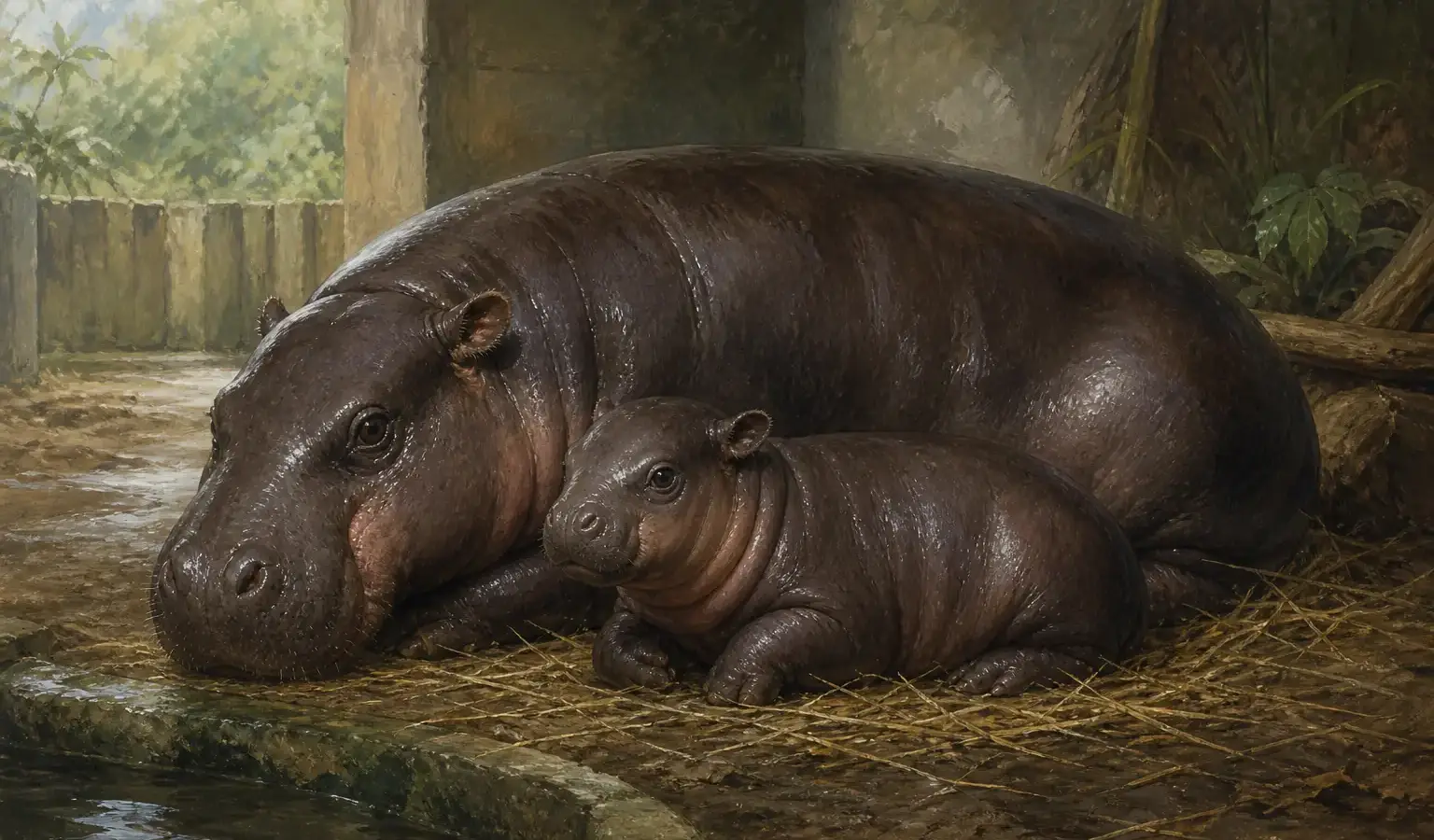
A female pygmy hippopotamus was born at Toronto Zoo on August 2, 2026. Within about 15 minutes she was trying to stand; roughly four and a half hours later, staff observed her nursing. She and her 20-year-old mother, Kindia, are being monitored away from visitors during their first days together.
For an Endangered species, a healthy birth is welcome. It is also easy to describe it too broadly. This calf does not increase the number of pygmy hippos in West Africa, restore forest or reduce hunting. Her immediate conservation role lies in a managed population held by accredited zoos.
The Toronto story becomes more meaningful when those two forms of work are kept distinct: preserving genetic options outside the species’ range, and protecting animals and habitat inside it.
A carefully planned birth
Toronto Zoo introduced Kindia to Harvey, a 31-year-old male, for eight days in January. The resulting calf was born after about an hour and a half of active labor. The zoo reported that mother and calf were doing well at the time of its August 5 announcement, while stressing that early calf survival can be challenging.
That caution is important. Birth is an event, not a survival outcome. The calf still has to pass through a vulnerable neonatal period before any claims about successful rearing are justified.
Kindia and Harvey participate in the Association of Zoos and Aquariums’ Pygmy Hippo Species Survival Plan. Such programs maintain studbooks and coordinate breeding and transfers among institutions. Pairing decisions consider relatedness, demographic needs, health and available space rather than allowing every animal to reproduce independently.
This is population management at a continental network scale. Its aims include limiting inbreeding and retaining genetic diversity over time in the population under human care. A birth can therefore be significant even when it has no immediate path to release.
It should not, however, be treated as a replacement for conservation in the wild. Toronto Zoo has not announced that this calf will be reintroduced, and the species’ principal threats cannot be solved by producing more animals in North America.
The wild population is difficult even to count
Pygmy hippos live in dense forests and wetlands in four West African countries: Liberia, Sierra Leone, Guinea and Côte d’Ivoire. Unlike the larger common hippopotamus, they are elusive forest animals. Direct observation is rare.
The IUCN lists the species as Endangered and describes a declining, fragmented population. Toronto Zoo cites an estimate of roughly 2,000 to 3,000 animals in the wild. That figure is best read as an indication of scale, not a precise global census. Sparse sightings, difficult terrain and uneven survey coverage make abundance and trend estimates uncertain.
The threats are clearer than the count. Forest is cleared and fragmented by agriculture, logging, mining and settlement. Hunting adds direct mortality. The IUCN Hippo Specialist Group also identifies water pollution and habitat degradation among the pressures facing hippos.
Fragmentation changes more than the number of hectares remaining. Small, isolated groups may have fewer opportunities to mix, and animals moving between forest patches face more human activity. Protecting a species that is hard to detect therefore requires protecting connected habitat even where individual animals are seldom seen.
What zoo-based conservation can contribute
An ex-situ population can retain biological knowledge and genetic options while wild populations are under pressure. Zoo animals have also supplied much of what researchers know about pygmy hippo reproduction, physiology and health, precisely because field observation is so difficult.
Those benefits come with limits. Conditions under human care differ from a West African forest, and a population can be demographically stable in zoos while the wild population continues to decline. Conservation value depends on how well institutions manage animal welfare and genetics, share data, fund field priorities and avoid presenting births as proof of species recovery.
Toronto’s involvement extends beyond the new calf. The zoo says its Endangered Species Reserve Fund supports development of a conservation action management plan through the “Ivory Coast Pygmy Hippo Program: Bending the Curve.” It is also listed among the partners supporting work by the Institute for Breeding Rare and Endangered African Mammals, or IBREAM, and Ivorian researchers at the Centre Suisse de Recherches Scientifiques.
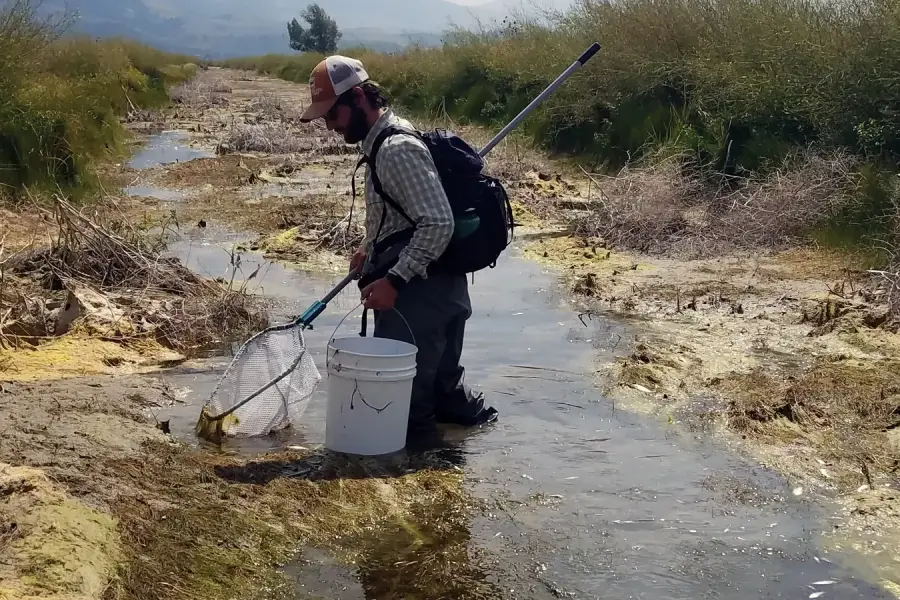
That team uses camera traps, scat surveys and conservation detection dogs in and around Taï National Park. In February 2026, researchers reported a rare night-time observation of a wild mother and calf while testing equipment for future tracking work. The sighting was encouraging, but its scientific value was not that two animals solved the population problem. It helped test methods for learning where pygmy hippos move and how they use a forest that is difficult for researchers to enter and survey.
Two measures of success
The calf’s progress can be judged on its own terms. In the near future, that means nursing, growth, health and a stable bond with Kindia. Over years, the Species Survival Plan can assess whether births and transfers maintain a healthy, genetically representative population rather than simply increasing the headcount.
Success in West Africa requires a different dashboard: credible distribution and abundance data, intact and connected forest, lower hunting pressure, and conservation plans shaped and carried out with range-country institutions and communities.
The two efforts can reinforce one another. Field projects need sustained funding and methods; zoo networks can provide money, expertise and public attention. Ex-situ research can answer questions that are nearly impossible to study in a secretive wild mammal. But the direction of accountability should remain clear. A zoo birth earns the label “conservation” most convincingly when it supports, rather than substitutes for, the work required where the species lives.
For now, Toronto has two pieces of good news at different scales. A closely watched calf has begun nursing beside an experienced mother. And the same institution is contributing to a field program trying to turn glimpses in a dark forest into evidence for better decisions. Neither should be inflated; both are worth following.