The goldfish carried home from a county fair looks like an unlikely invasive species. It is small, conspicuous and sold as a pet. Releasing it into a pond can even feel kinder than finding another owner.
Wyoming fisheries managers are asking residents to resist that intuition. Goldfish can survive the state’s winters, reproduce and establish populations that are difficult to remove. The concern is not hypothetical: managers have found goldfish in ponds and warm-water systems around the state, including May Park in Jackson and Kelly Warm Spring in Grand Teton National Park.
The evidence also needs to be kept in scale. Officials have not shown that a fish won at a particular fair created any named Wyoming population. Nor has a new study measured ecological damage from the fish reported at May Park. The annual warning is about closing a plausible introduction pathway before one unwanted pet becomes a management problem.
Why the warning follows county-fair season
SVI-NEWS published the Wyoming Game and Fish Department’s appeal on August 4, as county fairs were putting live goldfish into children’s hands. The department’s message was broader than one event: an animal that becomes inconvenient should not be transferred into the state’s waterways.
Teton County records show the issue had already reached local fair planning. At an August 2025 Fair Board meeting, Game and Fish asked carnival operator Frazier Shows to stop bringing goldfish because officials worried that unwanted prizes would be released. The following month’s minutes recorded a compromise centered on care sheets and an educational booth.
Those minutes document prevention, not wrongdoing. They do not show that the operator, the fair or an attendee released a fish. The distinction is important because “county-fair goldfish invade Wyoming” turns a risk pathway into an accusation the evidence does not support.
The pathway nevertheless makes sense. A prize fish may arrive without a tank, filtration or a household prepared for years of care. Release offers an immediate answer to that mismatch. Fisheries policy aims to intervene at that decision, when returning or rehoming one animal is still far easier than removing thousands of descendants.
A cold winter is not a reliable barrier
Goldfish are domesticated relatives of carp, not tropical ornaments that inevitably die when temperatures fall. Wyoming Game and Fish describes them as hardy enough to survive local winters and says breeding populations already exist in the state.
Survival alone does not guarantee invasion. A released animal must endure its new conditions, find compatible habitat and reproduce. Many pets released into the wild die. But risk management is driven by the minority that succeed: goldfish grow, reproduce quickly under favorable conditions and tolerate a range of environments that make establishment possible.
Managers found a recent example after a citizen reported fish at May Park in Jackson. A Game and Fish notice issued on August 5, 2025 says biologists then found goldfish in the park’s pond. The agency did not publish a population estimate, evidence of reproduction, a disease screen or measurements of water quality at the site.
That makes May Park evidence that goldfish were present, not a finding about how they arrived and not yet a quantified case study of ecosystem change. It does, however, show why public reports matter. Detecting conspicuous goldfish early may preserve management options that disappear after a population spreads through connected water.
What goldfish can change
The department identifies several mechanisms. Goldfish consume resources also used by native fish. While feeding near the bottom, they can disturb sediment and make clear water murkier. Dense populations can alter habitat and food-web conditions, and aquarium animals can move pathogens or parasites into wild communities.
These are credible risks, not a checklist of effects proven everywhere a goldfish appears. The May Park notice did not identify a pathogen or record a native-fish decline. The source article likewise reports agency warnings, not results from a site-specific ecological experiment.
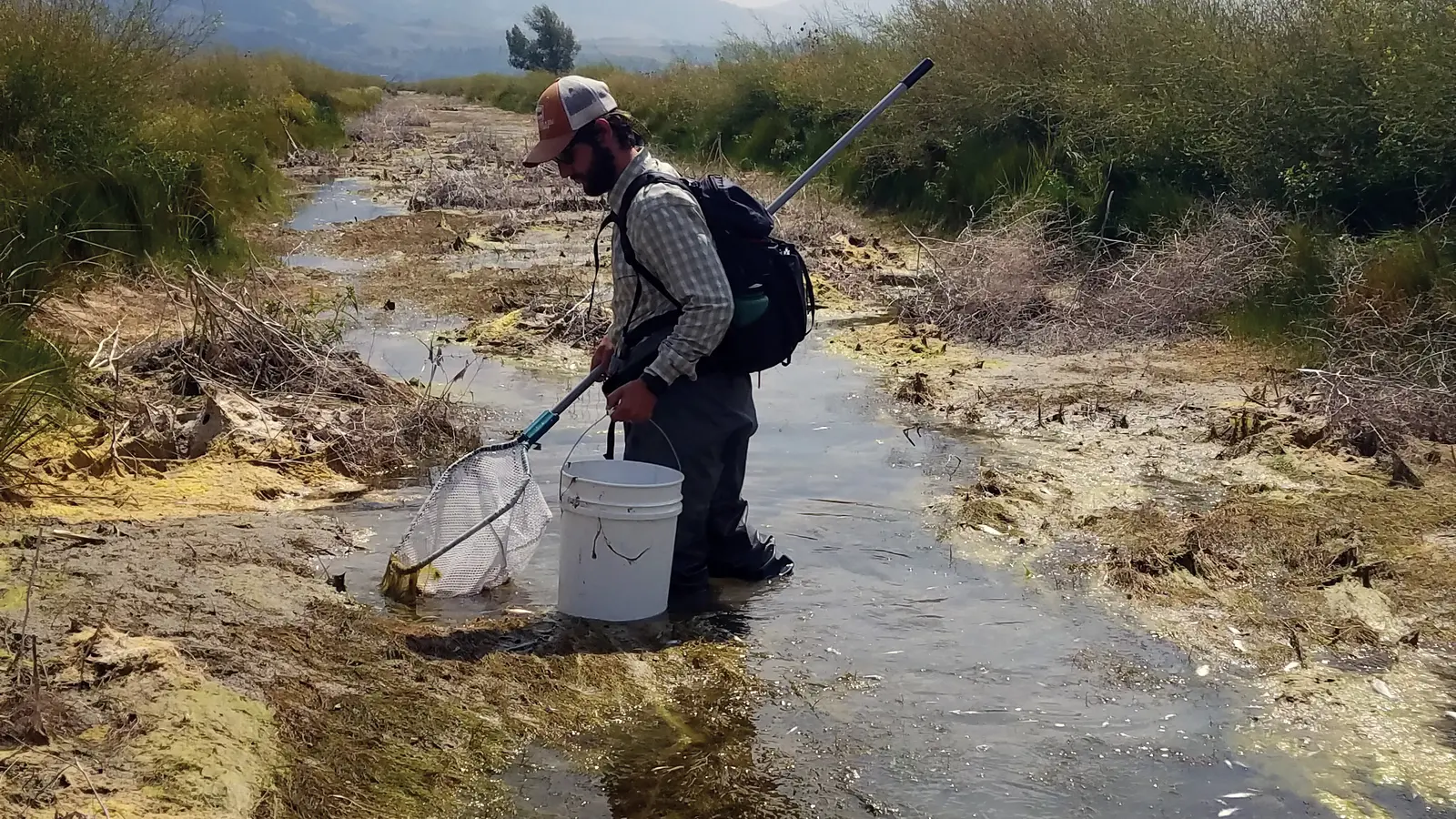
Kelly Warm Spring shows the longer management problem more clearly. The warm water near Grand Teton National Park has received aquarium releases for years and supported a mixture of nonnative species. Managers considered trapping, netting and electrofishing before treating the system with rotenone, a chemical that is toxic to gill-breathing organisms.
The National Park Service reports that the treatment killed approximately 600–700 pounds of fish but did not eliminate every invasive fish. That weight covered the collected fish assemblage; it was not 600–700 pounds of goldfish. The case illustrates both the scale removal can reach and its limits once several species occupy connected habitat.
The law treats introduction as more than littering
Wyoming Statute §23-4-101 prohibits planting or releasing fish or fish eggs in public waters without the consent and supervision of Game and Fish. A violation is classified as a high misdemeanor.
The maximum criminal penalty is up to $10,000 and up to one year in jail. Courts may also assess civil penalties up to the commission’s costs incurred in removing the illegally introduced fish. These are ceilings and discretionary remedies, not an automatic sentence for every case.
That severity reflects an asymmetry. The act of release may take seconds and cost nothing. Detection, genetic or disease testing, repeated netting, chemical treatment, cleanup, monitoring and restocking can occupy staff and funding for years. When fish move into connected water, complete removal may become impossible.
Possessing a goldfish is not itself prohibited. Wyoming allows goldfish and koi to be kept in aquariums or ornamental ponds when they remain confined. They may not be released into, or allowed to escape into, Wyoming waters. A garden pond that can overflow into natural drainage therefore deserves the same attention as deliberate dumping.
Better endings for an unwanted pet
Game and Fish organizes its advice as C.A.R.E. The first option is to contact the seller and ask whether it will take the animal back. Owners can then research another home through pet shops, aquariums, schools, shelters or experienced keepers. If no responsible placement exists, the agency advises humane euthanasia rather than abandonment.
The final step should be discussed with a veterinarian or an aquatic-animal professional. Methods appropriate for plants or invertebrates are not automatically humane for fish, and releasing a pet so that it may starve, freeze or disrupt a wild system is not a welfare solution.
Reports are useful too. A goldfish seen in an unexpected Wyoming water should be reported to Game and Fish rather than captured and moved elsewhere. A photograph and exact location can help biologists assess whether the sighting is isolated and what response is proportionate.
The department’s warning is not that every fair prize becomes an ecological disaster. It is that nobody can tell at the moment of release which fish will die and which will found a persistent population. Keeping that decision out of public water is a humane and scientifically defensible form of control.