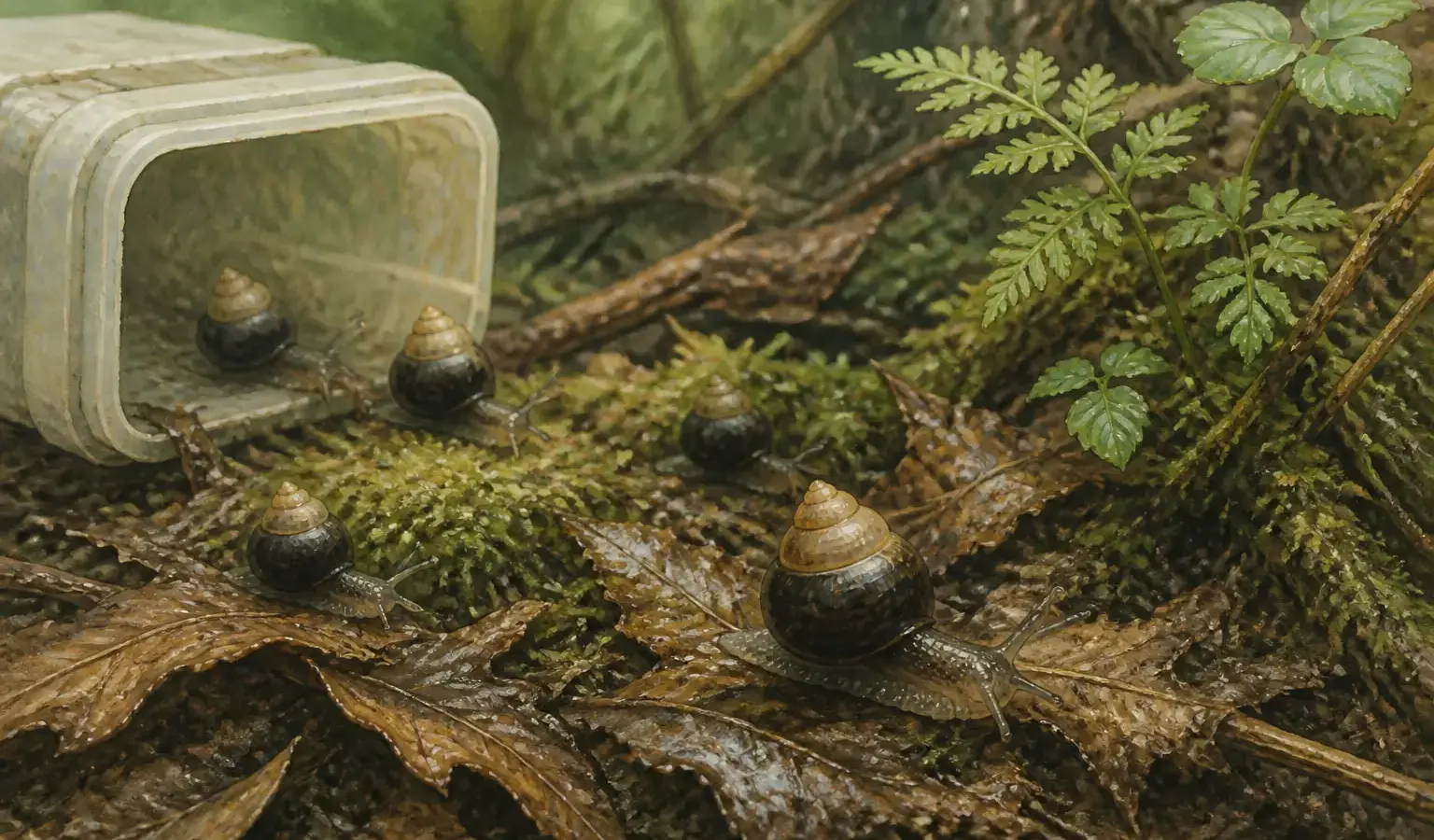
For decades, the Campbell’s keeled glass snail was known mainly through old records and empty shells. Then, in 2020, Norfolk Islander Mark Scott led Australian Museum researchers to a sheltered valley where a small surviving population had escaped notice.
Six years later, a conservation program has completed its second and final planned release. Taronga Conservation Society Australia announced that 1,000 zoo-bred snails had been flown from Sydney and placed in protected habitat in Norfolk Island National Park. Added to the 340 released in 2025, that brings the total returned to the wild to more than 1,300.
It is an unusual recovery story, but the number released is not its ending. The decisive evidence will accumulate much more slowly: whether the snails survive, produce young and establish a population that no longer depends on repeated additions from captivity.
Forty-six founders and a husbandry problem
The species is endemic to the Norfolk Island group, an Australian external territory in the southwest Pacific. Australia lists it as Critically Endangered. Its Red List history illustrates how slowly formal assessments can follow events: the IUCN entry is based on a 1996 assessment and still lists the species as Extinct, while Australian researchers have recommended reassessing it as Critically Endangered.
Rediscovery did not make the species secure. The 2020 surveys found it at one location, and the recovery team considered it at imminent risk of extinction. In 2021, 46 snails were taken into a purpose-built program at Taronga Zoo Sydney.
Captive breeding was not simply a matter of putting snails in a box and waiting. A peer-reviewed account of the program reports high birth rates at first, followed by high adult mortality. The team changed housing and care conditions to reduce stress. Births became sustainable, survival improved and the captive population grew rapidly.
The same work supplied basic natural-history data that had not previously been available. In captivity, the snails matured at roughly three to four months and lived for about 10 to 12 months. They are ovoviviparous: eggs develop inside the parent and live young are born rather than external eggs being laid. Those short lives and the logistics of maintaining a large, healthy population made husbandry knowledge part of the conservation intervention, not a side project.
By 2025 the captive population had passed 800. An Australian government permit application contemplated reintroducing as many as 2,500 zoo-bred animals over five years, alongside tagging and post-release monitoring. The actual program proceeded in two reported releases: 340 snails in July 2025, then 1,000 in 2026.
Reintroduction means rebuilding the conditions for survival
The snails were not released into an arbitrary patch of forest. Parks Australia assessed four possible locations and selected one that resembled the surviving population’s site in vegetation, temperature, humidity and predator abundance. Staff installed irrigation to maintain moisture during dry periods.
They also increased control of rats and feral chickens. Introduced predators are a central problem for island land snails, whose restricted ranges leave little room for losses or recolonisation. Norfolk Island has also undergone substantial habitat change and contains numerous introduced plants and animals. Captive breeding can increase the supply of snails; it cannot by itself repair those ecological pressures.
This distinction matters well beyond one species. A 2024 review led by the Australian Museum notes that land snails have more recorded extinctions than birds, reptiles, mammals or insects. They attract less attention than large vertebrates, but they contribute to leaf-litter decomposition and nutrient cycling, and many island species occupy exceptionally small ranges.
The Norfolk Island project therefore combined ex-situ breeding with habitat management, predator control and field monitoring. That integrated design is more informative than the headline release number.
What the first year can tell us
Monitoring after the first release found adults and wild-born juveniles at the site. Juveniles are especially important evidence: they show that at least some translocated snails survived long enough to reproduce under field conditions.
But reproduction is only one step in population establishment. Researchers will need to determine whether juveniles reach maturity, whether recruitment continues across seasons and dry periods, and whether deaths remain low enough for the population to persist. Counts also need careful interpretation when the animals are small, cryptic and easier to detect under some weather conditions than others.
The term “final release” can therefore mislead if it sounds like the recovery work is finished. It means the planned conservation-breeding and release phase has reached its endpoint. Researchers and national park staff will continue tracking survival, reproduction and population growth.
There is also a genetic question. Forty-six founders are far better than none, but every captive population carries only the diversity represented by its founders, and unequal breeding can reduce that diversity further. No program can recreate variation that was already lost before the surviving population was found. Genetic management and comparison with the remaining wild snails will matter as the new population develops.
The program has already achieved something substantial. It converted a single, acutely vulnerable population into a larger captive population and a second population under active management in the wild. It also produced practical knowledge about breeding a species whose biology was scarcely documented.
Whether it becomes a full recovery story will be decided in the leaf litter, not in the transport count. The most meaningful future announcement would be less dramatic than 1,000 snails boarding a plane: a monitoring series showing that descendants of those animals are still reproducing years later.