Thousands of dams across the United States hold back water without generating electricity. A new federal laboratory assessment asks an appealing question: could some of those existing structures add hydropower without requiring an entirely new dam?
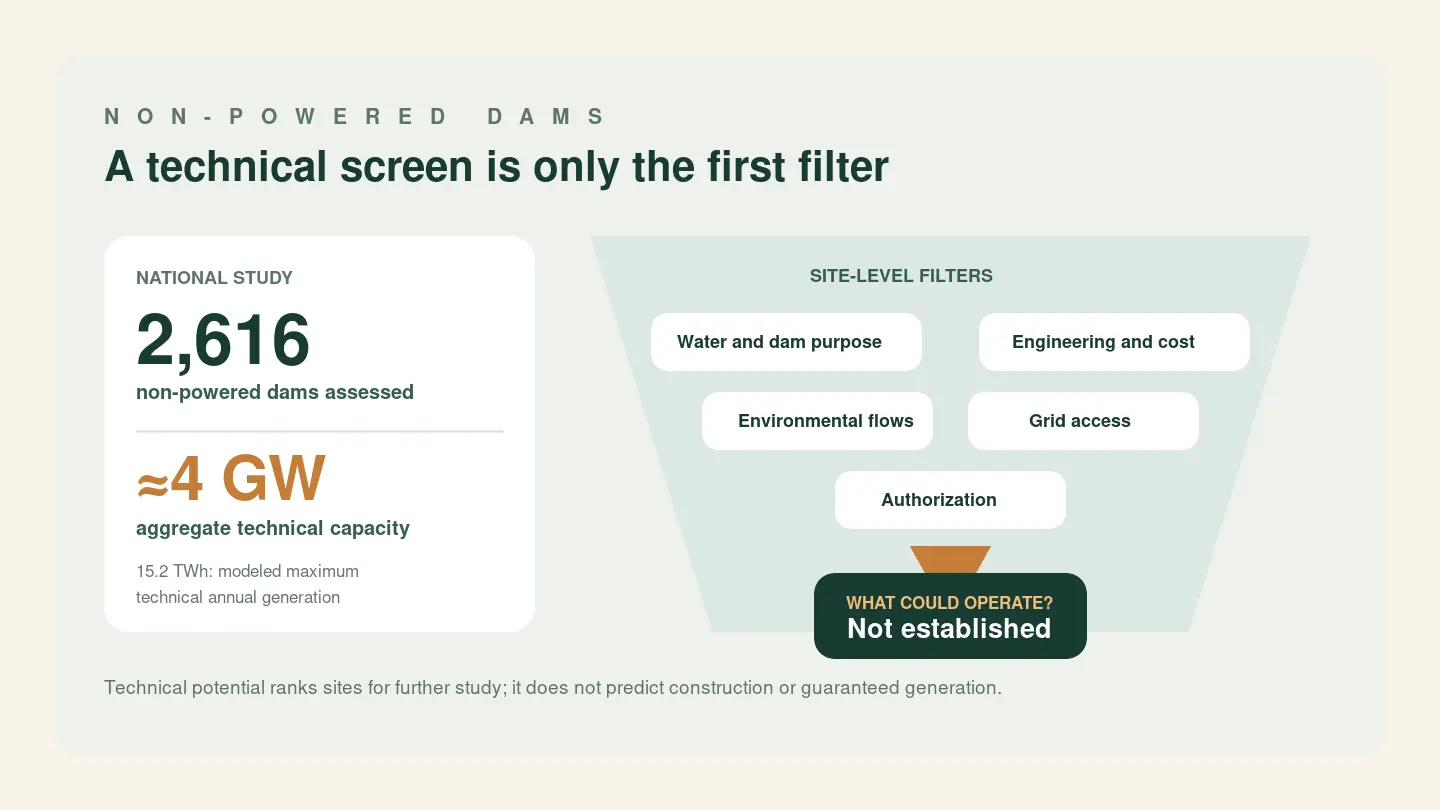
Researchers at Oak Ridge National Laboratory and Idaho National Laboratory evaluated 2,616 non-powered dams in the contiguous United States. Their technical report estimates that the sites collectively contain roughly 4 gigawatts of technical capacity under the study’s assumptions.
The qualifier is the substance of the finding. Four gigawatts is not a prediction of what developers will build, a total that has cleared environmental review, or a measure of electricity that would be produced over a year. It is an estimate of instantaneous generating capability at screened sites before economics, competing water needs, environmental flows, permitting and detailed engineering narrow the field.
That still makes the work useful. Rather than declaring thousands of dams ready for turbines, the assessment creates a more detailed map of where further investigation may be justified—and where basic physical constraints already make a project unlikely.
Existing concrete does not mean a ready-made power plant
Only about 3 percent of U.S. dams generate electricity, according to an Oak Ridge National Laboratory overview. Most were built for other purposes, including navigation, flood control, irrigation, water storage and recreation.
Adding generation to one of those structures can avoid building a new water-regulating dam. But it does not eliminate construction. A retrofit may still need a channel or pipe to convey water, a powerhouse, turbines and generators, an electrical interconnection, and modifications that do not interfere with the dam’s original responsibilities.
Hydropower potential depends on both the volume of water moving through a site and its hydraulic head—the elevation difference that gives the water pressure. A high-flow navigation lock or dam can therefore screen well even when its height is modest. Conversely, an imposing structure may offer little usable generation if flow, operating rules or access make the energy difficult to capture.
The report tries to move beyond a simple theoretical inventory by applying technical assumptions to individual sites. Estimated capacity ranged from 1 kilowatt to 222 megawatts. Among the 2,616 sites assessed, 1,090 exceeded 100 kilowatts and 298 exceeded 1 megawatt.
Those figures rank possibilities; they do not establish that the sites are viable. A modeled megawatt is still separated from an operating megawatt by design work, cost, permits and physical conditions that a national dataset cannot fully represent.
How the researchers built the estimate
The assessment is not a census of every dam in the country. It began with 3,299 sites in the contiguous United States that a 2012 theoretical assessment had already placed above 100 kilowatts. The researchers found 2,670 sites with enough matched information for the new analysis, then excluded 54 because their selected design flow was too low.
For the remaining 2,616, the model used daily streamflow covering 1980 through 2015. It selected a design flow that was exceeded 30 percent of the time, modeled one penstock, turbine and generator at each site, and assumed losses equal to 10 percent of the available hydraulic head.
The quality of the underlying information varies considerably. At 2,152 sites, the study combined modeled flows with head estimates inferred from dam height and purpose. Only 40 sites had both gauged flow and historical head observations. That imbalance does not invalidate a national screening exercise, but it limits how confidently its results can describe any particular dam.
Historical hydrology is another boundary. The 1980–2015 record provides a consistent baseline; it does not guarantee future river flow under changing climate, water demand or operating priorities. ORNL identifies projected-flow analysis as future work.
Capacity and annual electricity answer different questions
The headline figure—roughly 4 GW—describes modeled generating capacity. In practical terms, capacity is the rate at which a plant could produce electricity under specified conditions. It does not say how continuously that output would be available.
The report separately modeled 15.2 terawatt-hours of annual generation across the sites. That is an energy quantity accumulated over a year, but it is still not expected production. The analysis calls it maximum technical potential because it did not apply minimum flows needed for environmental protection or water supply, among other operational limits.
Real dams have obligations that take priority over electricity generation. They may need to maintain downstream habitat, serve navigation schedules, supply irrigation or drinking water, control floods, or preserve reservoir levels. Maintenance outages and seasonal variation also affect generation. Treating 15.2 TWh as guaranteed annual electricity would ignore the very constraints the report says remain to be modeled.
The site-level questions decide what gets built
The report deliberately stops before an economic assessment. It identifies several factors that could determine whether an apparently promising site survives closer examination: the length of the water conveyance route, the dam’s condition, the configuration of the proposed plant, proximity to transmission and the particulars of construction at an operating facility.
Environmental effects cannot be assumed away because a dam already exists. Diverting water through a turbine can change flows and operating patterns, and construction can affect aquatic and terrestrial habitats. The amount and timing of water available for generation may also be limited by legally or operationally protected uses.
Authorization depends on the site. The Federal Energy Regulatory Commission says a non-federal project meeting the jurisdictional tests of the Federal Power Act needs a license or exemption. A developer considering an existing dam can ask FERC for a declaratory order on whether the project falls within its jurisdiction. That federal question is one part of a broader development process, not an automatic approval path.
The new estimate is also not evidence that potential disappeared since an earlier national study. The report identifies 10.3 GW as the comparable theoretical estimate from 2012, but the new roughly 4 GW total reflects finer data and added technical constraints. Comparing the totals as if they measured the same thing would mistake methodological refinement for a physical loss of resources.
A shortlist for harder decisions
National screening studies are most valuable when they reduce a large universe of possibilities to a more manageable set. Here, the work suggests that some existing dams deserve detailed attention, particularly where flow and head combine favorably. It also shows why the appealing phrase “hidden hydropower” can oversimplify the task.
The infrastructure may already regulate the river, but the power system does not yet exist. Every candidate must be tested against the dam’s primary purpose, actual water availability, environmental obligations, engineering condition, grid connection, economics and public authorization.
The 4 GW figure is therefore a starting point for investigation. It measures what a national model found technically possible under stated assumptions. The capacity that ultimately becomes economical, permitted and operational—if any—will be determined one dam at a time.