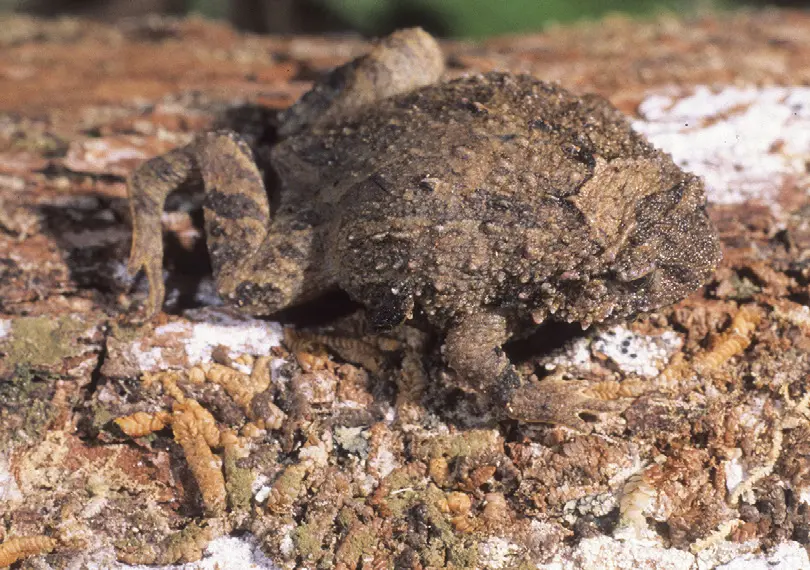
Seven newly named frogs do not simply add seven entries to a catalogue. In Madagascar, they redraw a patchy map of animals that can be hard to hear, harder to find and, in some cases, known from only a few preserved specimens.
The frogs belong to Rhombophryne, a genus commonly called the diamond frogs. A new 126-page taxonomic revision raises the number of recognised species from 20 to 27. The researchers did much more than compare colour and body size: they combined DNA, measurements, calls and three-dimensional scans of skeletons, including genetic material recovered from old museum specimens.
The result is simultaneously an expansion and a warning. Seven species now have names, yet several candidate species remain unresolved. And after reviewing the available distributions and threats, the authors estimate that 24 of the 27 recognised species should be considered threatened.
A species name is an evidence-based claim
Naming a species requires showing that a group of organisms can be distinguished from its closest relatives. That task is particularly difficult in a genus whose members are generally brown, secretive and thinly represented in collections. Some diamond frogs burrow; many call from concealed positions in leaf litter; and field teams may have to follow a call through dense forest only to search a square metre of ground for the animal producing it.
The revision therefore uses what taxonomists call an integrative approach. The team analysed mitochondrial and nuclear genetic markers, took detailed external measurements, compared advertisement calls and examined bones with micro-CT scanning. Those scans reveal internal structures without cutting apart rare specimens.
No single test automatically decides where one species ends and another begins. Genes can reveal separately evolving lineages, but genetic thresholds are not universal laws. Calls can be highly diagnostic in frogs, but calls are available for only 12 of the 27 diamond frog species. Body proportions and skeletons add further evidence, while also showing variation within a species.
The authors applied these lines of evidence conservatively. Their analyses indicate that two of the newly named species may contain additional genetic diversity, for example, but the team did not split them further without stronger support.
The seven additions are not variations on one design
The new species are Rhombophryne anatiala, R. kilonjy, R. kotrobaratra, R. maraorao, R. mavokely, R. quentini and R. sonaliae. They join a genus that is much more varied than the phrase “brown frog” suggests.
Across Rhombophryne, known adult body lengths range from 11.0 millimetres in the miniaturised R. proportionalis to 58.6 millimetres in R. vaventy. Some species are round-bodied specialised burrowers; others have longer limbs and a more gracile build. Several display reddish-orange patches, pale spots or eye-like markings near the hind limbs.
That diversity was obscured for much of the genus’s history. Rhombophryne was created in 1880 for one unusually stout burrowing frog and remained a single-species genus for more than a century. Genetic work beginning in the 2000s showed that several outwardly different frogs belonged in the same lineage. The new revision is the most complete synthesis of that transformed picture so far.
The pace of description reflects changes in effort and tools as much as changes in nature. The paper counts roughly one new diamond frog species every 18 years between 1880 and 2007. Since 2007, 20 have been named — about one every ten months. The frogs did not suddenly appear. More fieldwork, DNA barcoding, bioacoustics and accessible CT imaging made existing diversity easier to detect.
Museum specimens can answer new questions
Some of the most consequential evidence came from animals collected decades ago. The team used “museomics” methods designed for fragmented historical DNA to sequence name-bearing specimens of three species collected before 1976, along with other important museum material.
A name-bearing specimen is the physical reference that anchors a scientific species name. Comparing new samples with it can prevent researchers from attaching an old name to the wrong lineage — a real risk when similar-looking frogs have been collected from distant forests at different times.
The researchers obtained DNA sequences from the name-bearing specimens of 23 of the 27 recognised species and from topotypical specimens — animals collected at the original locality — for two more. That coverage allowed them to resolve several uncertain identifications and connect historical names with modern genetic data.
Collections cannot replace fieldwork. Candidate species were left unnamed in this revision because too few specimens exist or their distinctness remains ambiguous. Nor can a jar preserve an advertisement call, a breeding behaviour or the condition of a forest today. But museum specimens make modern surveys comparable with discoveries made generations earlier.
A richer taxonomy reveals a conservation problem
The study’s conservation analysis is stark. Of the 27 species, the authors recommend threatened categories for 24. They propose R. kilonjy, one of the new species, and R. matavy as Critically Endangered. Only R. nilevina and the newly named, broadly distributed R. sonaliae are suggested as Least Concern; one other species remains Data Deficient.
Habitat loss is the central concern. Diamond frogs are largely terrestrial animals associated with tropical or montane forest. Low-elevation populations can be especially exposed to logging, agricultural clearing and fire near the edges of protected areas. R. kilonjy is known from the Sahamalaza Peninsula, where forest is highly fragmented, while R. matavy is known only from low-elevation forest in Montagne d’Ambre National Park.
The map is not uniformly bleak. Marojejy National Park contains 11 of the 27 species, making it a centre of known diamond frog diversity. New records have also expanded some species’ apparent ranges. Better sampling may move some proposed assessments from Endangered to Vulnerable.
The missing natural history matters
Taxonomy can say which lineages exist and where specimens have been found. It cannot, on its own, explain how to keep them alive.
No egg or tadpole has been formally described for any Rhombophryne species, the authors report, apart from a published observation of a burrow containing young R. testudo. Their courtship beyond advertisement calls is unknown, and dietary information comes from only a handful of dissected or scanned specimens. Even basic reproductive biology remains uncertain.
Those gaps affect conservation decisions. Captive breeding, habitat management and survey design all work better when biologists know when animals reproduce, what their larvae require and how they respond to disturbance. For the most restricted species, acquiring that knowledge may be as urgent as refining the family tree.
The new names are therefore not a finish line. They turn scattered specimens, sounds and sequences into testable biological units. That makes decline easier to recognise and protection easier to target — while making the remaining ignorance impossible to overlook.