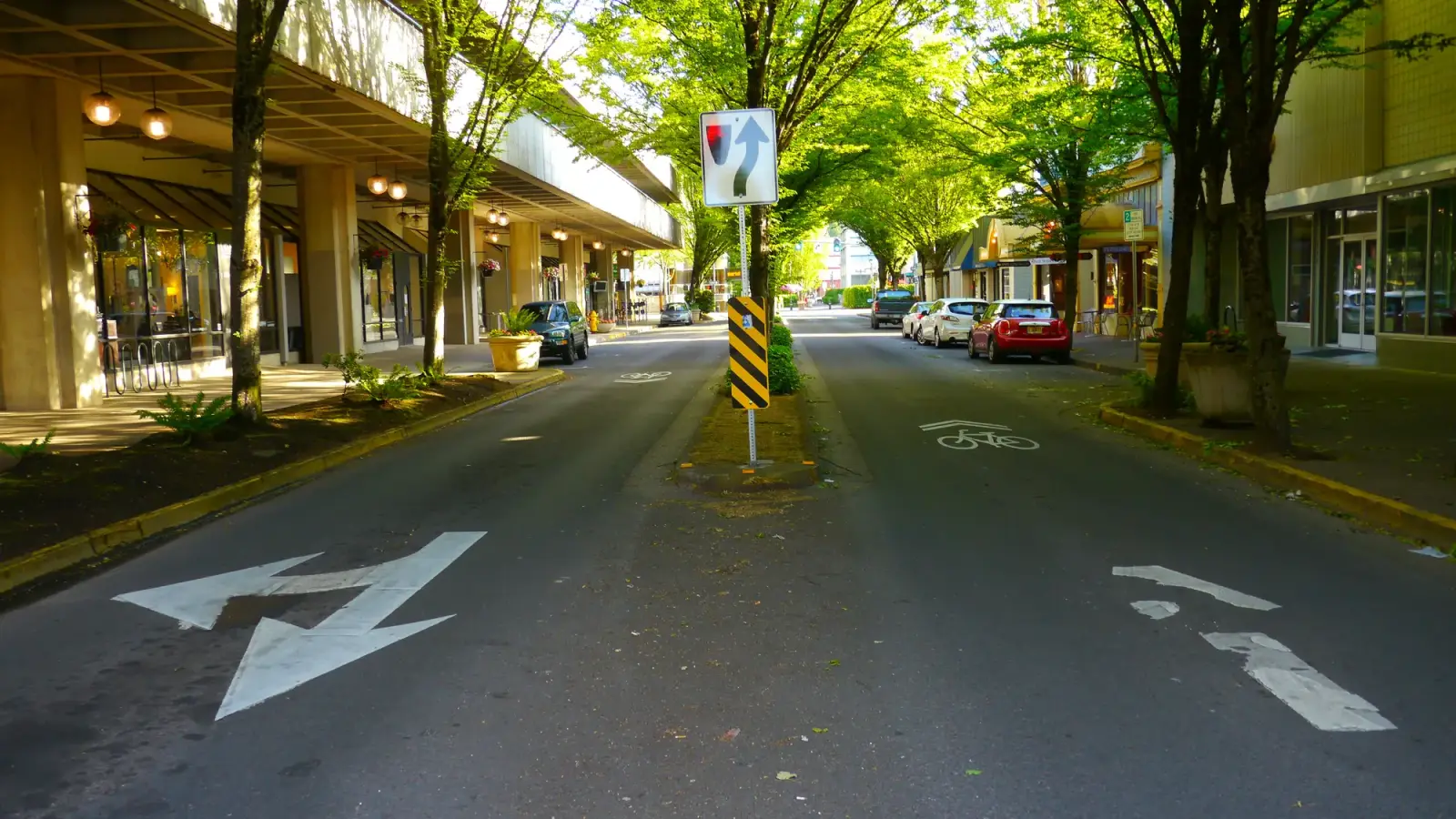
Eugene is preparing to remove one travel lane from parts of two of downtown’s busiest streets. But “remove” can make the proposal sound more final than it is.
The city plans a reversible pilot on the one-way Sixth and Seventh avenue couplet, where Highway 99 passes through downtown. The right-hand lane on each street would become parallel parking and curb extensions, using paint, planters, posts and modular curbs rather than a permanent reconstruction. The aim is to shorten pedestrian crossings, improve visibility and test whether a different allocation of street space works before Eugene invests in concrete.
According to Lookout Eugene-Springfield, the city intends to finish the design in fall 2026 and install the pilot in spring or summer 2027. Eugene’s current project page specifies summer 2027. Costs have not yet been published, and a council review expected in November remains tentative.
The crossing changes before the traffic signal does
Sixth carries westbound traffic and Seventh carries eastbound traffic through the centre of Eugene. Both are one-way, four-lane roads. Residents and nearby businesses have told the city that crossing them feels unsafe, according to the city’s project materials and the Lookout report.
The proposed design would not simply close a lane and leave unused asphalt. Parallel parking would occupy part of the space, while curb extensions would bring the apparent edge of the sidewalk farther into the roadway. A pedestrian would spend less time crossing moving-traffic lanes, and drivers and walkers could see around parked vehicles more easily at a properly designed corner.
Those mechanisms are well established enough to justify a test. Federal Highway Administration guidance says curb extensions used with on-street parking can reduce crossing distance and improve visibility. It also stresses that treatments require site-specific engineering. A design that works at one intersection does not establish the result at another, especially on a busy state-route couplet with freight and peak-hour traffic.
The city says the roads’ current design encourages speeds above the 20 mph limit. Cameras installed at nearby intersections in July are being used to study traffic and driving patterns. That work could provide a baseline, but no before-and-after result exists yet because the proposed layout has not been installed.
“Traffic will flow” is a forecast, not an observation
Eugene says a contracted engineering analysis concluded that traffic would continue to flow smoothly after the pilot. That assurance is important: one lane on each avenue would change function on a corridor that carries both through traffic and local trips.
The public summary, however, does not provide the report, vehicle counts, modeled peak periods, assumptions about future demand or a definition of “smoothly.” Readers cannot independently tell whether the conclusion refers to average travel time, intersection delay, queue length or another measure.
The measured question is not whether the project has “no effect” on traffic. Repurposing a lane is intended to alter how the street works. The useful test is whether any added delay or changed circulation is acceptable alongside shorter crossings, lower observed speeds, access to businesses and a more comfortable pedestrian environment.
That trade-off is why reversible construction matters. After installation, the city plans community engagement and evaluation in fall 2027. Its project page names vehicle speeds, pedestrian experience and traffic level of service among the measures. Paint and modular pieces can then be adjusted at much lower cost than a rebuilt curb.
One pilot within a three-part downtown package
The Sixth and Seventh avenue test is the most developed of three downtown transportation proposals described by Lookout. The others address walking connections and public space rather than the full length of the couplet.
On Oak and Pearl streets between Sixth and Seventh, Eugene is considering wider and more even sidewalks to improve the north-south connection between the downtown core and the 5th Street Market District. The city has not settled whether that work would remove a travel lane. Traffic analysis and design are still underway, and the proposal excludes the sidewalk beside the federal building.
At West Broadway and Olive Street, temporary planters and barriers would be replaced with permanent landscaping and irrigation. A city rendering shows a more finished public-space treatment north of Broadway. That is a separate project from the lane-and-parking pilot, even though all three are being presented as a downtown package.
The projects also sit near the planned North Butterfly Lot redevelopment at Seventh and Oak. Neighbours have asked for a quieter, more pedestrian-friendly Sixth and Seventh as that mixed-use development moves forward. This connects the street proposal to downtown development, but it does not prove the claimed economic benefits. More convenient parking, freight access and placemaking are objectives the city has named; business activity will have to be observed rather than assumed.
A pilot succeeds by producing an answer
Temporary street projects are sometimes discussed as if reversibility makes them inconsequential. It does not. Drivers, pedestrians, businesses and freight operators will experience a real change during the test. What reversibility changes is the cost of learning from it.
For Eugene, the evidence will come from comparing conditions before and after installation: vehicle speeds, queues and travel times; how long and how far people must cross; conflicts at corners; access for deliveries; and survey responses that distinguish comfort from measured safety. Public feedback can identify problems, but it should complement rather than replace traffic and safety data.
The proposal’s strongest feature is therefore not a promise that one fewer lane will automatically fix downtown. It is a design that can be tested and changed. If Eugene publishes the baseline, the consultant’s assumptions and the 2027 results, residents will be able to judge whether the streets became easier to cross—and what that improvement cost elsewhere in the system.