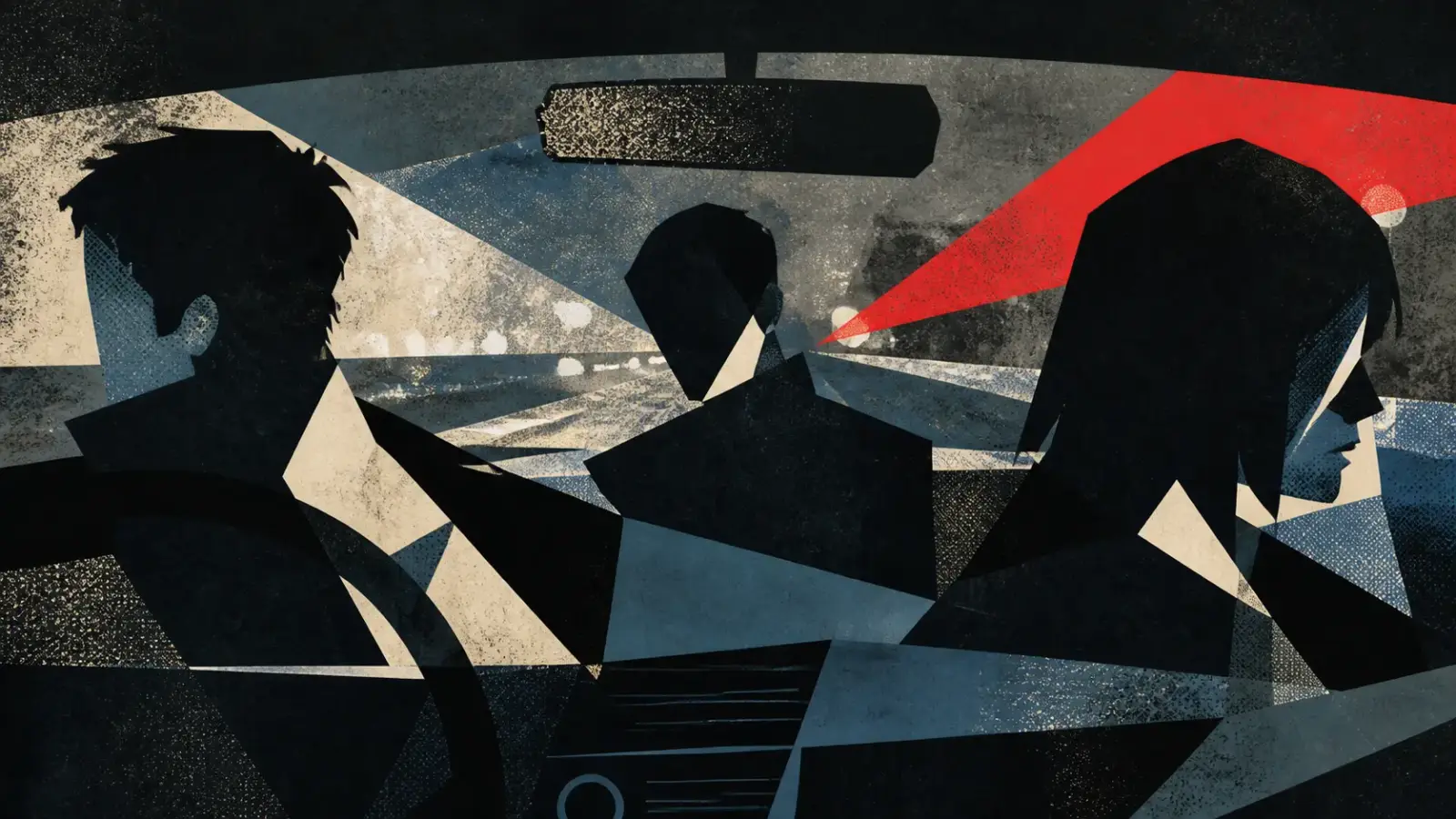
Most songs built around a romantic triangle spend their time explaining. “Love Crime” barely acknowledges that an explanation might exist.
The new track from Detroit punk duo CREDIT CARD lasts 2 minutes and 13 seconds. Its published lyric consists of seven short sentences. A narrator describes a ride involving a best friend and the friend’s girlfriend, who was previously the narrator’s partner. The title supplies the verdict, but the song page supplies no confession, confrontation or motive.
That refusal to fill in the scene is the track’s defining idea. The facts are simple enough to follow and incomplete enough to feel unstable. Instead of asking listeners to decide whether anyone wronged anyone, “Love Crime” lays three relationships across a sparsely described ride and ends before anyone can argue their case.
Eight sentences, no emotional instructions
The Bandcamp page presents a complete miniature rather than a fragment awaiting a chorus. Each line advances the arrangement of people: who is present, who belongs with whom now, and who belonged with whom before. The title phrase appears as a label for that configuration.
What is missing is more revealing than what is stated. The speaker does not tell us whether the earlier relationship ended cleanly, whether the friend knew, whether the current couple is comfortable, or whether the ride is tense at all. The word “crime” could name jealousy, a broken loyalty, an awkward joke or the narrator’s attempt to dramatise an ordinary romantic succession.
Because the language remains flat, the listener receives no reliable moral hierarchy. The narrator may be wounded, complicit, amused or simply reporting. The best friend and former partner never speak. A familiar pop-song situation is stripped of the cues that normally turn it into heartbreak, revenge or melodrama.
That economy prevents the title from becoming a literal claim. Nothing on the page suggests an actual offence or a biographical episode involving the band. “Crime” belongs to the song’s emotional vocabulary, not to a police report.
The production keeps the ambiguity moving
CREDIT CARD tags the release punk, industrial, synthpunk, eggpunk and nuwave. Those labels place the track in a synthetic, abrasive corner of punk, but they do not document how it was recorded or name a specific influence.
Writing for Austin Town Hall, Nathan Lankford hears sampled percussion, a rolling groove and layers of industrial texture. He compares its atmosphere to an older Nine Inch Nails mode while noting that “Love Crime” moves with less urgency. That is one critic’s useful description, not a production credit or a claim by the band.
The combination makes conceptual sense. A rolling pulse can keep the car-ride scene in motion, while a dense electronic surface supplies friction that the words refuse to express. The short running time also denies the arrangement a chance to swell into conventional catharsis. The track arrives, establishes the triangle and leaves.
Restraint is difficult to separate from absence when a song is this brief. Here, however, the lyric’s omissions are organised. Each sentence narrows the social geometry without solving it. The production, as described by Lankford, does not need to translate that geometry into a single emotion; it can make the unresolved space feel physical.
A single is not yet an album argument
“Love Crime” is listed as track four of the 12-track Devil’s Night / Dead Internet. The album is scheduled for August 14, 2026. At the time of writing, Bandcamp gives preorder buyers two songs: “Love Crime” and the preceding single “Harsh Times.” The digital preorder starts at $5, while a black-vinyl edition limited to 200 copies is listed at $25 with a 12-page booklet.
That release information defines the track’s context without turning two songs into a review of an unheard album. The album title suggests a broader frame, and the available tags suggest a coherent musical neighbourhood, but neither reveals how the remaining ten tracks develop it.
Post-Punk.com identifies CREDIT CARD as Shaun Hunter on vocals, synth and noise, and Max Dameron on programming, synth and guitar. Bandcamp describes the act more simply as a Detroit punk band. Neither source assigns individual roles or writing credits specifically to “Love Crime,” so the song should remain a band release rather than a production story built from inference.
The restraint also distinguishes this release from the promotional temptation to make every new single explain a whole scene. “Love Crime” does not need to stand for Detroit, industrial punk in 2026 or the complete ambitions of its forthcoming album. It succeeds on the smaller scale it chooses.
The hook is the missing case
The title invites a charge, and the lyric refuses to provide the evidence. That tension is more durable than a twist ending would be. Listeners can map their own assumptions about friendship, possession and romantic succession onto the scene, then notice how little the narrator actually confirms.
In 133 seconds, CREDIT CARD makes incompleteness feel deliberate. The song is not sparse because it lacks a story. It is sparse because the missing version of that story—the former partner’s, the friend’s, perhaps even the narrator’s honest one—is the part that keeps playing after the track stops.