The National Science Foundation is preparing an unusually direct test of how a U.S. STEM doctorate might be reorganized. Instead of treating industry experience as a summer detour from academic research, a new pilot will make work at a company part of the dissertation itself—and design the entire degree around four years of support.
The federal agency announced the initiative on July 29, describing a $47 million investment over five years alongside commitments from universities and companies. The program aims to support more than 250 doctoral students, with the first cohort planned for fall 2026.
Those are targets, not results. No student had begun the program when NSF announced it. The pilot has not yet shown that participants can finish in four years, produce strong dissertations, find better jobs, or have a healthier graduate-school experience. What it has created is a framework for testing a different relationship among students, universities, and employers.
More than an internship
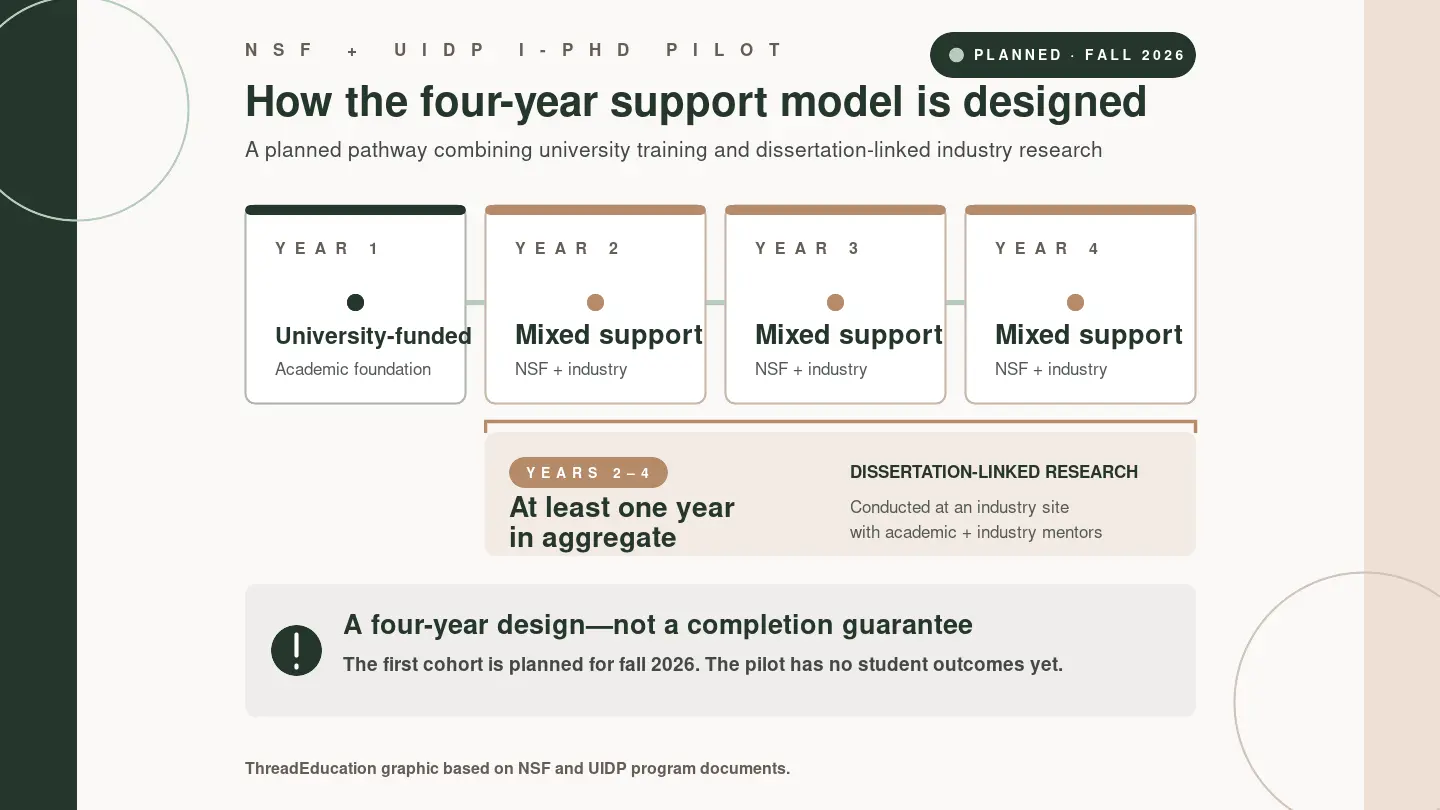
The Industry-Integrated PhD Scholars Program, led by the University-Industry Demonstration Partnership, is not structured as a conventional internship added to an otherwise unchanged degree. Students are expected to remain full-time at their home universities, work with both academic and industry mentors, and spend at least one year in aggregate conducting research at a company site.
That research is supposed to be integrated into the dissertation. In principle, this could connect a doctoral project to equipment, data, engineering constraints, or operational questions that are difficult to reproduce on campus. It could also give students sustained exposure to how research decisions are made outside a university.
But integration creates obligations that a short placement can often avoid. If work done at a company becomes central to a dissertation, students need to know in advance whether they can publish it, present it at conferences, and defend it publicly. They also need a workable plan if a company changes priorities, ends a project, or decides that a result is commercially sensitive.
The public program materials recognize that these issues exist. University-company pairs must document the project scope, selection process, mentoring structure, intellectual-property rules, publication and confidentiality arrangements, and placement plan before taking part. UIDP says its role is to assess whether organizations are ready to participate, rather than judge the scientific merit of each proposed project.
That leaves much of the consequential detail to individual partnerships. There is no single publicly described rule that will govern publication delays, ownership disputes, or conflicts between a student’s academic needs and a company’s commercial interests across the entire pilot.
A four-year funding design
The program’s financial structure is meant to align those partnerships with a four-year path. Universities fund the first year. For each of years two through four, UIDP lists a $37,000 stipend, a $16,000 cost-of-education allowance, and $22,000 associated with the industry experience. Industry partners must contribute at least $100,000 per student, including at least $25,000 upfront, while NSF supplies additional co-funding.
That is more complicated than saying NSF simply pays for the final three years. NSF’s announcement refers to support for the “remaining years” after the university-funded first year, while the detailed UIDP description presents years two through four as a shared arrangement involving federal and industry money.
The four-year design is also a timetable, not a guarantee. Doctoral research does not always obey a fixed schedule: experiments fail, access to data changes, equipment breaks, and promising questions lead in unexpected directions. A compressed structure could improve planning and remove funding uncertainty. It could also reward safer, narrower projects if partnerships treat the deadline as more important than the research.
Applications for fall 2026 and fall 2027 are nonbinding and reviewed on a rolling basis. Organizations displayed by UIDP have expressed early interest and support, but that does not mean every one is a confirmed participant. Later cohorts will depend on whether partners are ready and have the capacity to host students.
Where STEM graduates actually work
The strongest rationale for industry-integrated training is not that every doctoral student should leave academia. It is that many graduates in several major STEM fields already do.
The National Center for Science and Engineering Statistics reported that, among 2024 doctorate recipients who had definite plans for non-postdoctoral employment in the United States, business or industry accounted for 74.2% of engineering jobs, 70.7% in the physical sciences, and 65.4% in computer and information sciences.
Those percentages require all of their qualifiers. They exclude graduates without definite plans, people entering postdoctoral positions, and people whose planned employment was outside the United States. They do not establish that most STEM Ph.D. recipients overall enter industry. Across all fields within that same restricted group, industry and academia were nearly even: 8,266 people reported industry or business commitments and 8,098 reported academic ones, each about 40%.
The underlying Survey of Earned Doctorates is an annual census of U.S. research doctorate recipients; its 2024 frame included 58,131 people. But employment plans are self-reported around graduation, so they capture one moment rather than a person’s full career.
The data nevertheless expose a persistent mismatch worth examining. Doctoral training is typically organized inside academic departments even in fields where a large share of graduates with definite job commitments are headed to companies. A dissertation that includes serious industry research could make that transition less abrupt without reducing the doctorate to job training—if the academic component remains genuinely independent and rigorous.
What a meaningful evaluation would ask
The pilot’s first test is whether the participating institutions can make the model work in practice. A student with two mentors could benefit from complementary expertise, or be caught between two sets of expectations. A company placement could open access to valuable tools, or constrain what a student can disclose. A four-year funding package could provide welcome certainty, or turn an aspirational schedule into pressure to finish before the work is ready.
Completion time alone would therefore be a poor scorecard. A serious evaluation would also need to examine attrition, publication and dissertation quality, delays caused by confidentiality review, student compensation and workload, mentoring disputes, and employment outcomes. It would need to ask who is selected and whether the structure works across fields with very different research timelines.
NSF has framed the initiative as a pilot, which is exactly how it should be read. The interesting claim is not that four-year, industry-integrated doctorates have already succeeded. It is that more than 250 planned student experiences could generate evidence about whether this model produces rigorous research while better reflecting the institutions where many scientists and engineers ultimately work.
The answer will come from the cohorts, not the announcement.