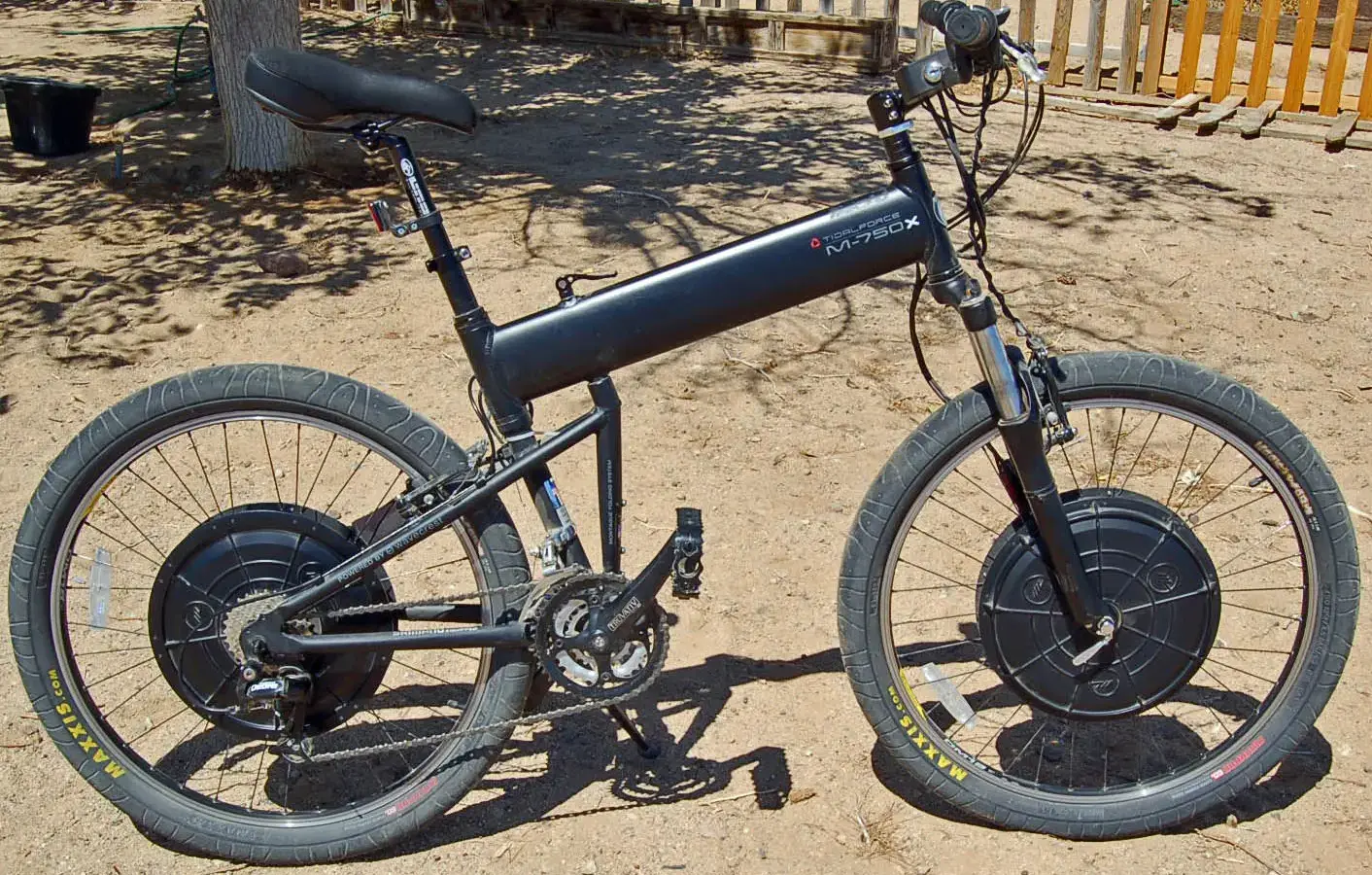
A 15-year-old rider doing wheelies toward oncoming traffic on Glenwood Street prompted Garden City police to issue a warning this week. According to the department’s account, officers cited the teenager; nobody was injured, and police said a serious collision was avoided.
The unsafe riding is the uncomplicated part. The machine’s legal identity is not. Products sold as “e-bikes” now range from low-speed pedal-assist bicycles to electric motorbikes capable of road-vehicle speeds. A manufacturer’s label, a pair of pedals or a software-limited riding mode may not place them in the same category under local and state law.
Garden City responded in July with a new definition for high-speed electric motorbikes and scooters. It gives police a local rule for where those machines may be used. But the frequently repeated shorthand—anything over 750 watts is a motor vehicle that simply needs a licence and registration—leaves out a critical second question: whether the particular machine qualifies to be titled and registered for public-road use at all.
The incident behind the warning
CBS2 Idaho News reported the Glenwood Street incident on August 5, relying on information from Garden City police. The account says the rider was 15 and was cited after performing wheelies in the direction of opposing traffic.
Those are police allegations, not findings from a completed court case. The report does not identify the machine’s model, documented motor rating, maximum design speed, federal certification or eventual charge. It therefore cannot serve as a worked example showing precisely how Idaho classified this vehicle.
What the incident does illustrate is the practical problem behind the new ordinance. Two machines that resemble bicycles from a distance can differ greatly in acceleration, weight and speed. Riders and parents may also assume that pedals or an “e-bike” product description preserve bicycle status even when the machine’s performance falls outside the statutory definition.
Garden City created two alternative tests
The City Council adopted Ordinance 1068-26 on July 13, 2026. Its definition of a high-speed electric motorbike covers a two- or three-wheeled vehicle propelled at least partly by an electric motor when either of two conditions applies:
- motor output is greater than 750 watts; or
- the machine is capable of more than 28 miles per hour under motor power alone or through motor and human power combined.
The word or matters. A machine does not need to cross both thresholds. A lower-powered model capable of exceeding 28 mph can meet the local definition, as can a more powerful model whose current settings keep it below that speed.
The code also looks beyond the rider’s behavior at the moment of a stop. It applies according to how a vehicle is designed, manufactured, modified or operated. Once a machine meets the definition, a manufacturer’s different label, functional pedals, a temporary low-power configuration or a selected slow mode does not change that classification.
Garden City prohibits these high-speed machines on its bike lanes and paths, sidewalks, crosswalks and the Boise River Greenbelt. On city streets and roadways, the ordinance requires them to be titled and insured. Emergency and police vehicles, authorized government equipment and qualifying mobility devices are among the exceptions.
An ordinary violation of the chapter carries a $100 penalty plus court costs. The specified penalty for unlawfully operating a high-speed electric motorbike or scooter is $300 plus costs. The code also allows impoundment where other law permits it; it does not require officers to impound every machine.
Idaho’s e-bike exemption is narrower—and not identical
State law supplies the next layer. Under Idaho Code §49-106, an electric-assisted bicycle must have operable pedals and a motor rated at less than 750 watts. It must also fit one of three classes:
- Class 1 provides assistance only while the rider pedals and stops assisting at 20 mph.
- Class 2 can propel the bicycle without pedaling but stops providing motor assistance at 20 mph.
- Class 3 assists only while the rider pedals and stops assisting at 28 mph.
A machine meeting that definition retains the general rights and duties of a bicycle, subject to lawful restrictions imposed by local governments or public agencies. It is also expressly exempt from driver-licence, financial-responsibility, title, registration and licence-plate requirements.
The boundary contains an awkward detail. Idaho’s definition says the motor must be less than 750 watts. Garden City’s local definition of a regular electric bicycle permits no more than 750 watts, while its high-speed category begins above 750 watts. Exactly 750 watts therefore sits differently in the two texts unless speed or another characteristic resolves the issue.
There is a second ambiguity that a wattage sticker alone cannot solve: Garden City’s code says “motor output” but does not specify whether that means nominal continuous output or a short peak. Electric-drive marketing commonly displays both. The ordinance should not be rewritten in practice by assuming one measurement the text does not name.
“Not an e-bike” is not yet a complete vehicle class
Idaho’s title-and-registration provisions do not put every self-propelled device into one residual bucket. The code separately defines motorcycles, motor-driven cycles, mopeds and motorbikes. For title and registration, applicable federal motor-vehicle safety standards are part of the definition. The consequences are not identical: an electric moped that meets Idaho’s specific definition is not required to be titled and does not require a motorcycle endorsement.
That is why the Idaho Transportation Department’s guidance is more careful than the common instruction to “go register it.” A qualifying motorcycle or motor-driven cycle needs the appropriate title, registration and plate. Its rider generally needs a motorcycle endorsement to operate on a highway, and a rider under 21 must complete an approved motorcycle-rider training course. Insurance requirements apply to road motor vehicles as well.
But a machine designed and sold as an off-highway electric motorbike may lack the manufacturer’s certification label, road equipment, documentation or vehicle identification record needed for that process. Idaho provides a conversion affidavit for certain two-wheel motorbikes, yet the owner must certify compliance with current federal safety standards and state equipment law. The form is a compliance route, not a waiver.
The distinction changes the advice a family needs. If a product is a statutory e-bike, ordinary e-bike rules apply. If it is a high-speed machine that also qualifies for an Idaho road-vehicle category, title, registration, insurance and rider authorization may make road operation possible. If it cannot meet those vehicle requirements, Garden City’s ordinance does not create a third path simply because its owner is willing to pay a fee.
Local access rules and state vehicle law do different jobs
Garden City’s high-speed category is useful precisely because enforcement cannot wait for every retail label to become consistent. It sets performance boundaries for the city’s streets, paths and Greenbelt, while preserving the ordinary treatment of compliant e-bikes.
It should not, however, be described as a statewide reclassification. Idaho’s e-bike statute has not changed. Nor should Garden City’s thresholds be copied from nearby Boise: the two cities use similar approaches but not identical inclusive language at their boundaries.
For riders, the safest sequence is to identify the exact motor rating and design speed before purchase; determine whether the machine meets Idaho’s three-class e-bike definition; and, if it does not, confirm with the Idaho Transportation Department whether that specific make and configuration can be titled for road use. Licence applies to the rider, while title and registration apply to the machine—another distinction lost when all requirements are compressed into one warning.
The Glenwood Street account is fundamentally about hazardous riding. The law surrounding the machine is a separate lesson: once electric performance moves beyond the bicycle exemption, the answer is not supplied by wattage alone.