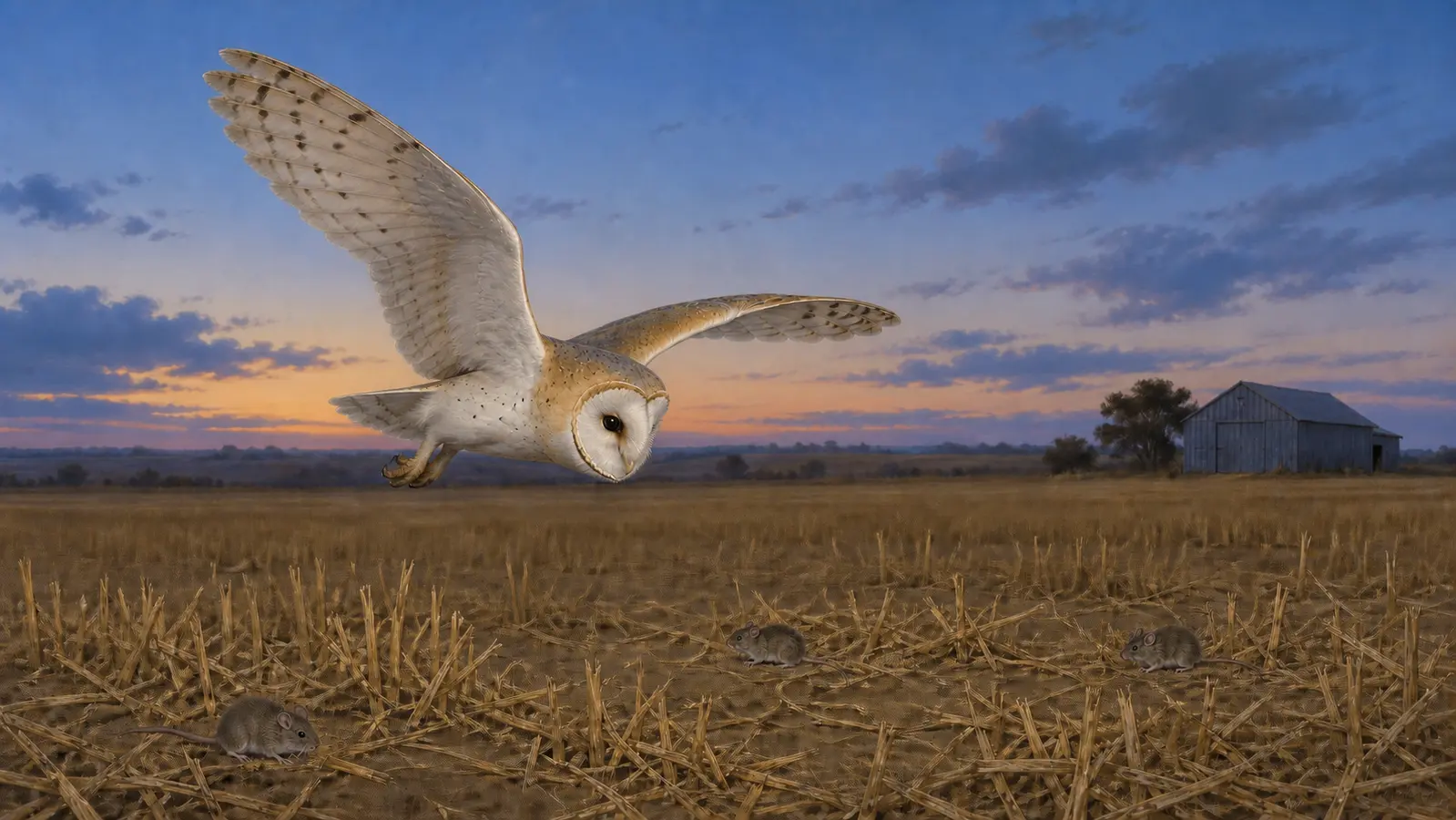
Seven young barn owls emerged one by one from a grain silo in Western Australia’s Chapman Valley this winter. Farther south, near Moora, four clutches were recorded in artificial hollows originally installed for endangered Carnaby’s cockatoos. Each held between three and five eggs or young birds.
The sightings followed an extraordinary abundance of house mice across parts of the state’s grain belt. They make ecological sense: barn owls can respond quickly when small-mammal prey becomes plentiful, breeding more often and raising larger broods than lean seasons allow.
But the word boom needs care. The state’s Department of Biodiversity, Conservation and Attractions told ABC that it has no program recording barn owl numbers, leaving these reports without a standardized statewide measure. What is visible so far is a cluster of local observations—striking broods, more sightings and more birds reaching wildlife carers—consistent with a prey-driven breeding pulse. The distinction matters because the other half of such a pulse begins when the mice disappear.
What farmers and carers are actually seeing
Chapman Valley property owner Melanie Pugh found the seven owlets in July, according to ABC Midwest & Wheatbelt. Their parent or parents continued feeding them for several weeks before the young birds fledged. On the same property, the number of mice caught in traps fell from about 150 a day in May to about 10 a day by late July.
Those two observations occurred together; one does not establish the cause of the other. Trapping, seasonal weather, depleted food and changes in mouse breeding could all contribute to a local decline. Barn owls commonly prey on mice, but the report did not measure the diet of these birds or how much their predation reduced the infestation.
Near Moora, Dean Arthurell of the volunteer group Carnaby’s Crusaders found four barn owl clutches during a visit to artificial nesting hollows. The three-to-five-egg or nestling broods were another sign that the adults had enough food to invest in reproduction. The timing may also limit competition with the cockatoos for which the hollows were installed: Arthurell expected the owls to finish much of their breeding before Carnaby’s cockatoos began examining the sites to lay.
Wildlife organizations elsewhere in the Midwest and Wheatbelt have reported more barn owls in care or in the landscape. Yet the state’s Department of Biodiversity, Conservation and Attractions told ABC it was not aware of a recent increase and had no program recording barn owl abundance. These accounts therefore describe where people looked, found nests or received birds—not a standardized sample of the state.
Why a mouse plague can produce more owlets
For a predator, a mouse outbreak is not simply more food on an average night. It changes the energetic limits on breeding. Adults can deliver prey more frequently, support more nestlings and, under favorable conditions, attempt a second clutch instead of waiting for another season.
Long-term Australian fieldwork supports that mechanism. A study of 14 barn owl nests in north-western Victoria during 1987–90 recorded clutches of three to six eggs, usually four or five. Productivity ranged from two to five fledglings per attempt. Consecutive autumn and spring clutches occurred when prey was most abundant. After measured mouse density fell by roughly 80%, clutches became smaller, breeding was confined to spring and nestling mortality increased.
That work was published in Australian Field Ornithology in 2025 from observations made decades earlier and more than 2,000 kilometers from the current reports. It is useful evidence for how the response can work, not a retrospective census of Western Australia.
Diet studies supply the other part of the picture. In small pellet samples collected at two arid-zone sites in South Australia and New South Wales, house mice accounted for 88% and 99% of prey items by number. The samples—47 pellets or fragments at one location and 15 at the other—were highly local, but they show that house mice can make up almost the entire sampled diet at a particular place and time.
The 2026 mouse evidence is also uneven across Western Australia. The national winter mouse forecast, issued in June through a GRDC–CSIRO monitoring project, described a plague in the northern grain-growing region around Geraldton and concerning activity in parts of the Sandplain and Esperance regions. Other surveyed areas were lower overall, with localized high patches. A severe outbreak in one district should not be converted into uniform conditions across a state spanning more than 2.5 million square kilometers.
The bust follows the feast
The abundance that helps one cohort fledge does not guarantee its survival. Mouse populations can contract rapidly when food and weather cease to favor breeding. More young owls then compete for fewer prey and suitable roosts at the same time that inexperienced hunters are leaving their natal sites.
Raptor carer Janelle Ende told ABC that this is when starving or displaced birds tend to arrive in care. Some appear in conspicuous or unsuitable places; others are harassed by other bird species as they disperse. A rise in admissions after a mouse plague would therefore not contradict the earlier breeding success. Both are stages of the same boom-and-bust response.
Field observations from north-western Victoria found the same broad sequence: owl numbers tracked mouse availability, breeding stopped after the prey crash, and the owls eventually left the study site. Movement makes local abundance especially difficult to interpret. More sightings can reflect successful breeding, incoming dispersers, or simply birds becoming easier to notice.
Rodent control can change the risk to predators
The relationship between mice and owls is complicated by poison. Barn owls can be exposed after eating rodents that consumed anticoagulant bait. Wildlife carer Michelle Jones suggested that local campaigns encouraging residents to move away from second-generation anticoagulant rodenticides, or SGARs, may also have helped more young birds survive.
That is plausible, but it has not been measured in these broods. Neither the ABC report nor the evidence cited here provides a local time series linking bait use or chemical residues in birds to nesting success. Changes in poison use should therefore remain a hypothesis rather than a second proven cause of the apparent increase.
The regulatory context has nevertheless shifted. Australia’s pesticides regulator concluded that existing uses of five SGAR active ingredients posed unacceptable risks to non-target animals. In March 2026 it suspended the registrations for one year while allowing tightly specified supply and use under official instructions. That action is not a total prohibition on every rodenticide, and “owl-safe” should not be treated as a blanket property of all alternatives.
Predators are also not a substitute for a full outbreak-management strategy. Nest boxes can supply scarce breeding sites and owls remove rodents from fields, but the Western Australian observations do not quantify crop protection or replace sanitation, monitoring and legally approved controls. The defensible lesson is narrower: retaining habitat and reducing avoidable toxic exposure give native predators a better chance to exploit a prey pulse that already exists.
A successful season, with the outcome still open
The silo brood and recorded clutches are genuine reproductive events. They show individual barn owls successfully raising young during a reported mouse outbreak; the link to greater prey availability is a well-supported ecological explanation, but was not directly measured in these nests. The observations make that familiar relationship visible at a moment when mice have imposed heavy costs on farms and towns.
Whether 2026 becomes a lasting increase in local barn owl numbers depends on what happens after fledging: how quickly prey declines, where juveniles can settle, their exposure to poisons and roads, and how many survive the lean period. Without repeatable counts, the strongest conclusion is not that Western Australia has acquired a new population of owls. It is that several districts have caught the productive phase of a predator following its prey—and the difficult phase is likely to come next.