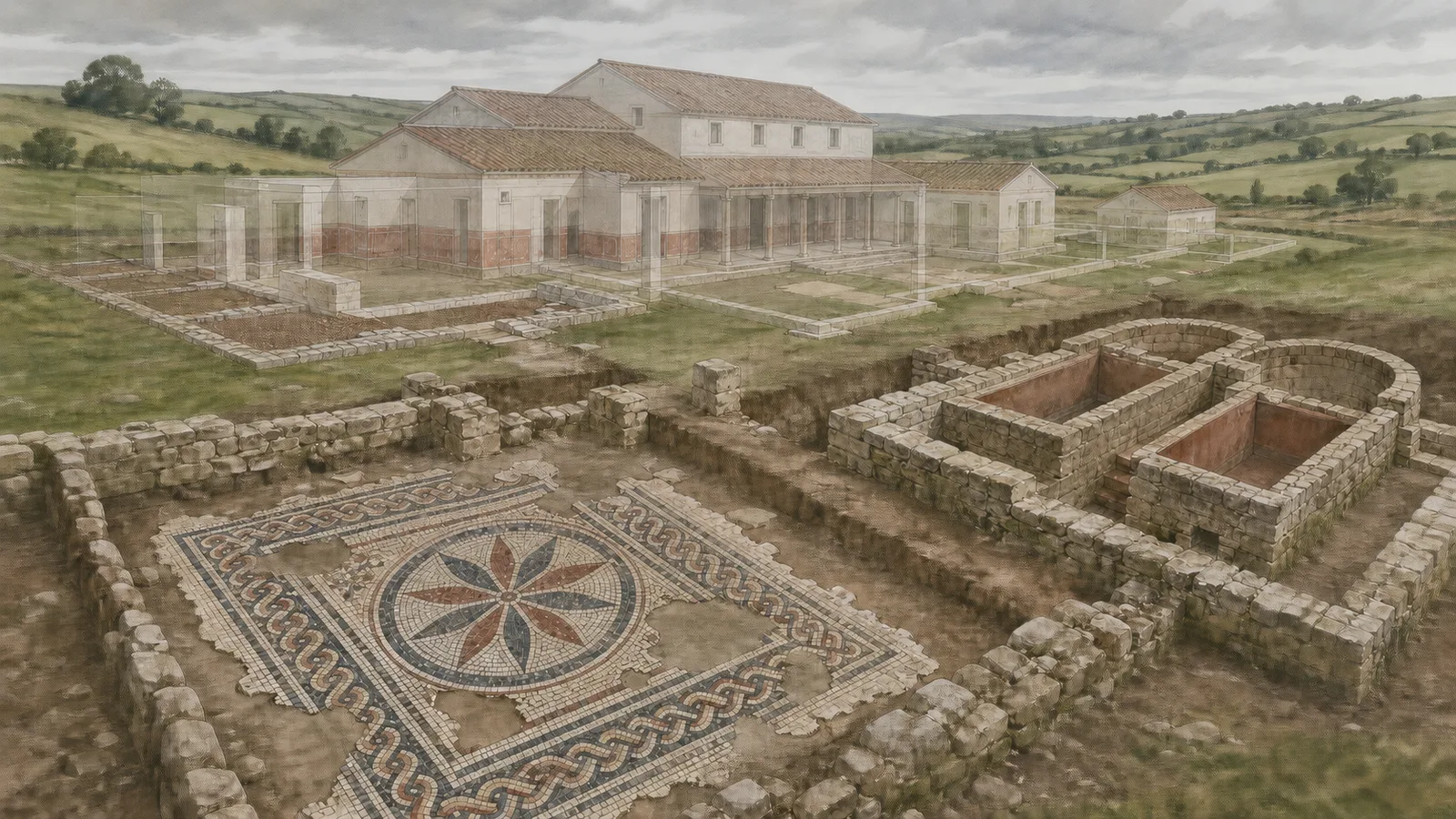
The most immediately legible object uncovered beneath a Devon field is a floor. Thousands of small red, off-white and dark blue-grey stones form an eight-petalled flower, interlaced squares and a braided border. Even in its damaged state, the mosaic communicates what its owners intended: this was a room designed to be seen.
The excavation around it tells a less decorative but more consequential story. The residence was larger than archaeologists had expected. Rooms had been added at both ends, a possible stair suggests an upper floor, and a separate bath building contained at least two plunge pools. Nearby structures and finds point to storage, cooking, agriculture and craft as well as display.
Together, those remains make the site unusually valuable in a county where excavated Roman villas are scarce. They do not offer a frozen portrait of one wealthy household. They record an estate that appears to have changed over roughly two centuries—and a first major excavation whose interpretations are still being tested.
A site known for 22 years, not a sudden discovery
The villa lies under farmland between Halberton and Sampford Peverell in mid-Devon. A local metal detectorist identified the site in 2004. Subsequent fieldwalking, metal detecting and geophysical survey indicated several phases of buried archaeology: the residence, two other Roman buildings, enclosures, land divisions, walls and floor surfaces.
Trial trenches exposed part of the mosaic in 2021. Coins, brooches, building material, worked slate, industrial debris and loose tesserae had already made clear that this was more than an isolated decorated room. Evidence of a possible underfloor-heating flue and the damaged mosaic suggested a high-status building occupied, on current evidence, from the middle of the second century into the fourth.
The threat was also clear. Ploughing had disturbed the upper archaeology and dislodged parts of the floor. That vulnerability led to SHARE—Saving Halberton’s Ancient Roman Environment—a five-year community project led by the University of Exeter and Cotswold Archaeology with Devon County Council, local societies, students and volunteers. The National Lottery Heritage Fund supports the work.
The 2026 field season combined an initial evaluation with eight weeks of excavation. Sixty-five archaeology students worked alongside professional archaeologists and scores of volunteers in two large trenches. It is the first of three planned annual excavation seasons within the wider five-year project.
That history matters because “archaeologists discover a villa” compresses several different acts into one headline. The location was known; remote survey supplied a plan; small trenches tested it; and only then did a larger excavation expose enough connected architecture to revise the interpretation.
What makes the mosaic exceptional
The surviving mosaic covers about 12 square metres and was probably installed in the fourth century. Its tesserae are small—around 12 millimetres square in the finer design—and use three main colors. At the center, teardrop-shaped petals overlap to form a stylized flower. Interlaced squares and guilloche, a two-strand braided pattern common in Roman mosaic work, frame it.
Around the edge, larger and coarser pale limestone tesserae appear to have served parts of the floor exposed to heavier traffic. That change is easy to miss in a photograph focused on the central roundel, yet it shows the floor was functional architecture as well as decoration.
Archaeologists think the room may have been used for dining or reception. The suggestion is plausible: an expensive patterned floor would have structured how guests encountered the house. But no inscription labels the space and its furniture is gone, so the room’s precise use remains an interpretation rather than an identified fact.
Devon’s county archaeologist describes it as the westernmost polychrome mosaic yet found in a villa in Roman Britain. “Yet found” is essential. The claim reflects the current archaeological record, which is shaped by where sites survive, where surveys happen and what later building or agriculture has destroyed.
Only part of the floor remains in its original position. Specialists are lifting the surviving mosaic so it can be stabilized and eventually displayed at Tiverton Museum of Mid-Devon Life. Removal sacrifices some of the immediate relationship between floor and room, but leaving a plough-damaged mosaic in active farmland would carry a different risk. Detailed recording before and during lifting is what preserves that context for later study.
The bathhouse changes the scale of the household
Away from the main residence, one stone building contained at least two large tanks interpreted as plunge baths. Their inner surfaces were lined with opus signinum: lime mortar mixed with crushed ceramic material to create a water-resistant finish. Painted wall plaster adds evidence that this was an elaborate room rather than a purely agricultural water installation.
The bathhouse was unexpected not because bathing was unknown in Roman Britain, but because it required resources beyond the pools themselves. Supplying, heating and draining water demanded construction skill, fuel, maintenance and labor. A private bath suite therefore records an operating system as much as an elite taste.
Several objects reinforce the impression of status. A blue-glass intaglio depicting Victory would once have been set into a ring and could be pressed into wax as a seal. Excavators also found a delicate copper-alloy bracelet, a silver-plated spoon and fine pottery, including a late-third- or fourth-century drinking beaker and a Samian mortarium with a lion-shaped spout.
These objects do not identify the owners. Wealthy occupants need not have come from Italy, and a goddess on a seal does not establish a person’s private beliefs. What the finds demonstrate is participation in networks of objects, skills and social practices that extended across Roman Britain and the wider empire.
A villa was also a workplace
The newly exposed plan suggests that the house grew in stages from a more modest rectangle. Rooms were added to its north and south ends. Walls and a rainwater gully at the rear may mark a practical zone used for kitchens or storage, while traces interpreted as a timber staircase raise the possibility that part of the residence had two storeys.
A second detached stone building may have been a barn or another agricultural structure. Quantities of animal bone and worked antler were recovered there. Those remains help correct the picture created by the mosaic: a villa was not only an owner’s decorated home but the center of a productive rural estate, dependent on people whose names and living spaces are usually much harder to recover.
The distinction is especially important when discussing “Romanisation.” The term once encouraged a simple story in which people at the empire’s edge became progressively more Roman by adopting baths, mosaics and imported goods. Archaeologists now use the concept more cautiously. Material culture can reveal aspiration, connection and selective cultural choices; it does not measure a community’s identity on a single Roman-to-local scale.
The Halberton household clearly invested in forms associated with prosperous Roman life. The excavated evidence does not tell us whether its members thought of that choice as imitation, belonging, political positioning or something else. Nor does one exceptional estate establish how most people in Roman Devon lived.
The next seasons may matter more than the showpiece
Future excavations will move beyond the residence to neighboring land. That is where archaeologists can test how the estate was organized, what it produced, how buildings changed through time and how the site’s later use and eventual abandonment unfolded.
Post-excavation work will also refine the sequence. Pottery and coins can narrow dates; animal bone and plant remains can illuminate food and farming; building materials can distinguish remodeling from collapse or stone-robbing. The recovered objects must be conserved, catalogued and studied before the preliminary story becomes a formal site report.
The mosaic deserves attention. It is rare, intricate and vulnerable, and its eventual display will make an otherwise buried site publicly legible. But its greatest research value comes from not treating it as an isolated treasure. Set beside the baths, extensions, drains, animal remains and working buildings, it becomes one element in a changing household economy at the western reach of Roman Britain.