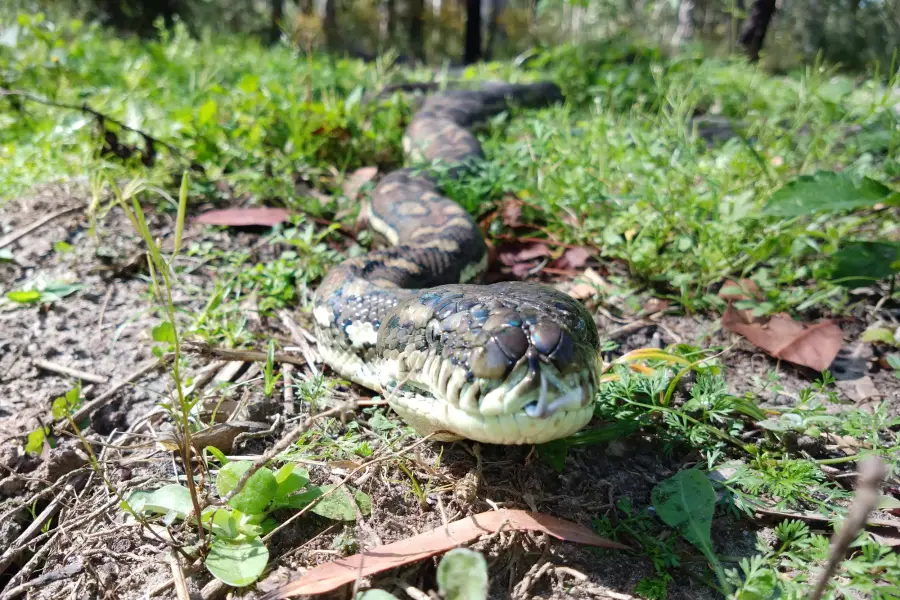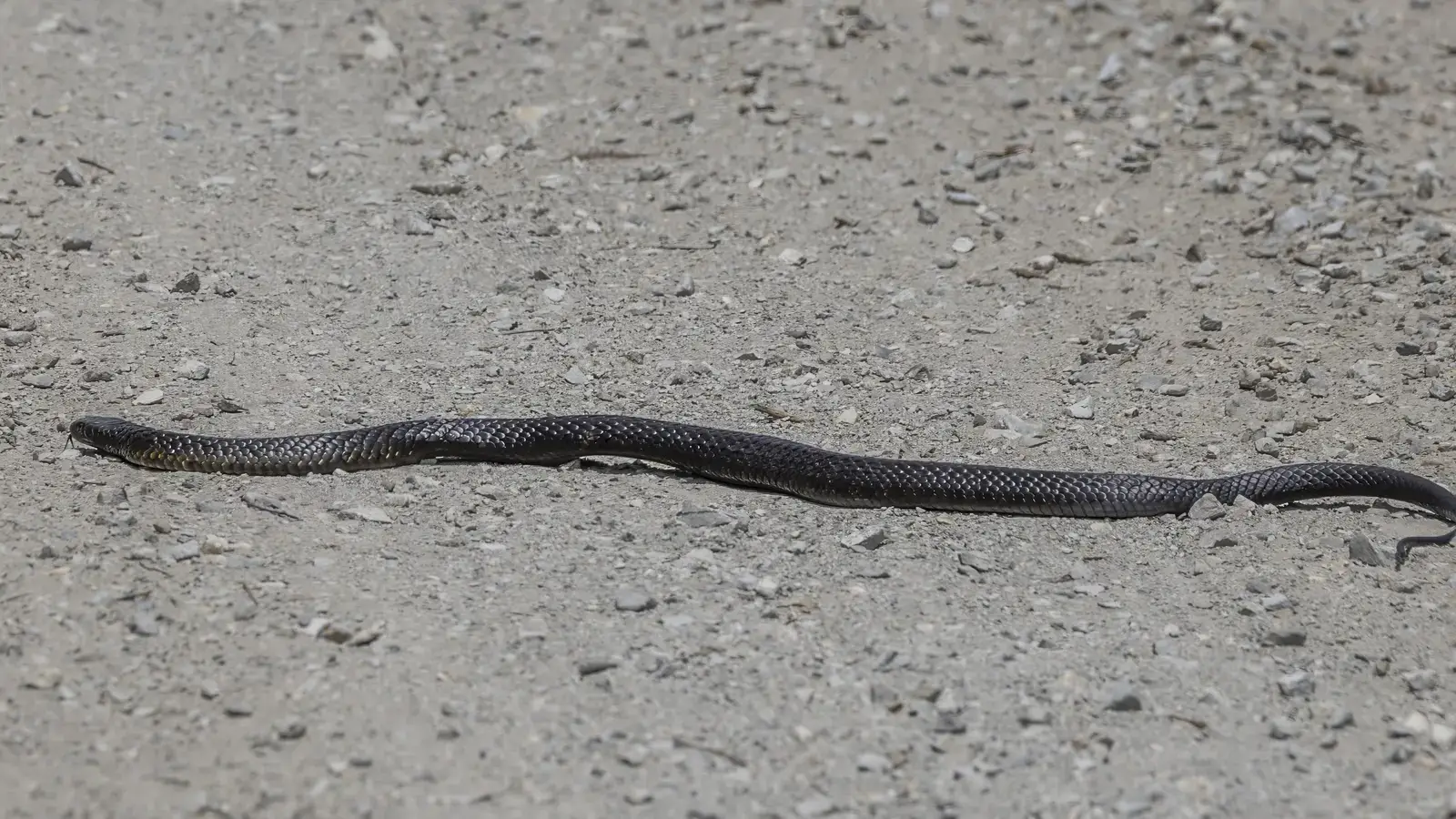
A snake looks like a head followed by a long, repeating trunk. Its ribs extend far down the body, its limbs are gone and the usual landmarks that divide a four-legged animal’s back are difficult to see. The apparent simplicity helped sustain an old anatomical idea: perhaps elongation had reduced the snake’s body to one gradually changing series of vertebrae.
Detailed measurements now resolve a different pattern. Researchers who analysed the body vertebrae of three Australian elapid snakes found that the column is best described by four or five regions. At the finest sampling resolution, they identified five: a short cervical region, or neck; three thoracic regions; and a small lumbar region at the rear.
The work does not discover visible segments on a living snake. It detects changes in the three-dimensional shape of vertebrae, then asks where those changes shift direction along the column. The result matters as much for how anatomy is measured as for the inevitable question of where a snake would wear a necktie.
A region is a pattern, not a gap
In mammals, vertebral regions can be recognised with familiar structural cues. Neck vertebrae differ from the rib-bearing thorax; the lumbar vertebrae of the lower back lack ribs; and the sacrum connects the spine to the pelvis. Snakes have lost the limbs and most have ribs along nearly the entire body in front of the cloaca. Their boundaries are subtler.
Yet subtle is not the same as absent. Individual vertebrae carry projections, articular surfaces and proportions that vary along the body. Developmental patterning — including the action of Hox genes during embryonic development — can organise those differences even when there is no sharp external landmark.
A 2015 study used vertebral shape to challenge the idea that snake trunks were developmentally uniform. It recovered four regions in the precloacal column: cervical, anterior thoracic, posterior thoracic and lumbar. Later work across 63 species also found four morphological regions and showed that the boundary between the two thoracic regions correlated with heart position.
The new analysis asks why earlier studies may have missed still finer structure. The answer, in part, is sampling density.
Measuring every vertebra changes the map
The researchers studied eastern brown snakes (Pseudonaja textilis), lowland copperheads (Austrelaps superbus) and tiger snakes (Notechis scutatus). Their formal analysis comprised complete body-vertebra sequences from 12 elapid snakes. The lead author’s accompanying public account says 13 specimens were measured; the paper’s abstract does not explain the discrepancy.
Instead of selecting a few representative bones, the team used three-dimensional geometric morphometrics to quantify landmarks on vertebrae throughout each column. They then fitted segmented regressions: statistical models that locate points where the trajectory of shape change switches.
To test what resolution does to the result, they repeated the analysis after subsampling at intervals of 2%, 2.5%, 4% and 5% of the column. They also compared different sets of anatomical landmarks.
The complete and finely sampled data favoured four- or five-region models. The five-region interpretation divides the body into cervical, anterior thoracic, middle thoracic, posterior thoracic and lumbar sections. The middle thoracic module had not been distinguished in earlier work.
Coarser sampling progressively erased the smallest regions. In the authors’ tests, sampling every 2.5% of the column was the coarsest strategy that still reliably recovered the pattern. The finding is a methodological caution for comparative anatomy: when a region occupies only a few percent of an animal, skipping a handful of bones can make it disappear statistically.
The neck stayed short while the thorax expanded
The cervical region occupied roughly 2% to 4% of the analysed columns in the peer-reviewed paper. In a public explanation of the work, lead author Ammresh described the neck as about 5% of body length, or approximately seven to 12 vertebrae.
That is much shorter than an earlier estimate extending the snake neck to about 15% of the body. It is also broadly comparable in vertebral count to the necks of limbed lizards. The implication is not that snake bodies lengthened evenly. The cervical region stayed compact, while most elongation took place in the thoracic series.
The thorax did not simply acquire more identical units. It was repatterned into three modules. One especially strong shape transition occurred around 20% of the column and aligned closely with heart position, reinforcing the earlier finding that internal organs and vertebral patterning are related.
At the opposite end, the analysis found a lumbar boundary within the final 5% of the body column. That region is easy to overlook because snake lumbar vertebrae do not announce themselves with the same obvious loss of ribs seen in many four-legged animals.
Elongation did not mean anatomical simplification
Limbs provide tetrapods with multiple structures that can change independently as species adapt to running, digging, climbing or swimming. A limbless animal has fewer appendages to modify, but its long axial skeleton offers many units whose proportions and connections can evolve.
The five-region pattern fits a broader view of snake evolution in which an ancestral regional plan was retained and modified, rather than erased. The neck and lumbar region persisted at the ends; the greatly expanded thorax acquired internal subdivisions.
That does not prove what each newly resolved module does mechanically. Shape can suggest different loading, muscle attachment or mobility, but this study primarily detects morphological boundaries. Linking those boundaries to locomotion, breathing, organ support or ecology will require functional tests and a broader comparison of species.
The next step is to test the diversity hidden by the average
The three sampled species occupy different ecological settings, and the study detected shape differences among them. Those differences were not distinct enough for the method to identify species reliably from vertebral shape alone.
That limitation is useful. It prevents a regional pattern shared by these elapids from being mistaken for a ready-made identification tool, particularly for isolated fossils. It also points toward the scale of the next question.
There are thousands of living snake species, from burrowers scarcely thicker than a pencil to large constrictors, sea snakes and arboreal specialists. Comparing complete columns across that diversity could test whether the same boundaries recur, whether some regions have been lost or multiplied, and how regional shape changes with locomotion and habitat.
For now, the central result is precise and limited: in these Australian snakes, fine-grained measurement turns an apparently repetitive backbone into a structured sequence. The simple tube was an artefact of looking too coarsely.